About F#sus2sus4 — uncommon voicings
F#sus2sus4 is F#, G#, B and C# — with the second added underneath the fourth.
It sounds ringing and deliberately ambiguous. Read another way it is a stack of fourths, which is why it works as a pad rather than as a chord that resolves.
Texture more than function — still no third.
Also written F#sus2/4 or F# suspended 2nd and 4th.
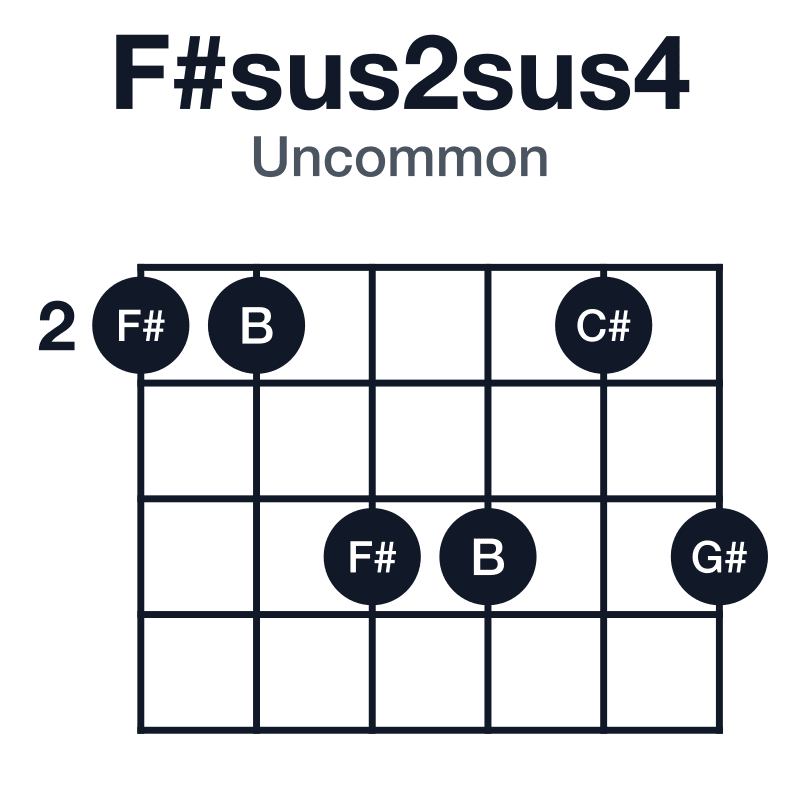
What these less common shapes are
How to use F#sus2sus4
In which keys. Every note of F#sus2sus4 belongs to C# minor (the iv), Eb minor (the ♭III), E major (the ii), F# major (the I), F# minor (the i), Ab minor (the ♭VII), A major (the vi) and B major (the V).
What to play over F#sus2sus4
Every note of F#sus2sus4 is in F# major, F# natural minor, F# dorian, F# mixolydian and F# harmonic minor.
Each of those is a page: the scale across the neck, and the chords it harmonises into — which is where F#sus2sus4 sits in it. Every scale.
Chords near F#sus2sus4
Change one note of F#sus2sus4 and you have (drop the fourth), (drop the second), (the fourth becomes the major third), (the fourth becomes the minor third), (the second becomes the flat seventh) or (add the flat seventh).
F#sus2sus4 is a suspended chord — root and fifth, with a second or fourth where the third would be — or nothing at all. Suspended and power chords on every root.
The common shapes and the derived voicings come from different places, and both are explained in how this site is built.