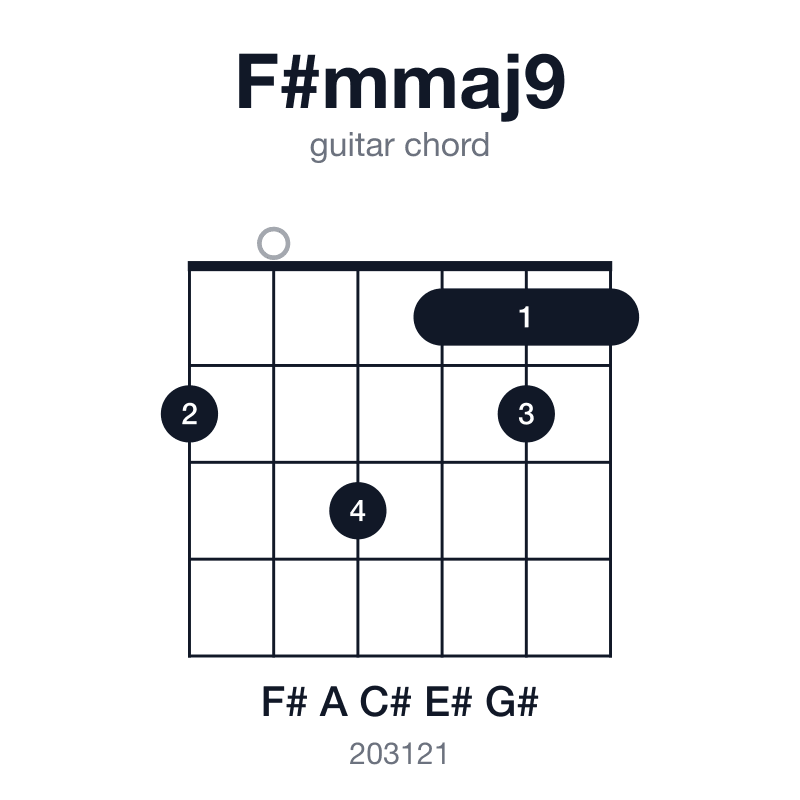
F#mMaj9 guitar chord
3rd inversion · E# in the bass
1 of 3
- Tap a note to hear it
- Arrows change position
- Fingers, notes or intervals
- Play the chord
About F#mMaj9
F#mMaj9 is F#, A, C#, E# and G#. It keeps every note of and adds the .
F#mMaj9 and both contain the 9th. The difference is the 7th: F#mMaj9 uses , while uses the flat 7th.
Choose between them by the seventh under a held 9th. The minor 3rd remains in both chords.
Also written F#mM9, F#m(maj9) or F#-Δ9.
How to use F#mMaj9
How you get to it. The turn that lands on F#mMaj9 is to : the ii and the V of F# minor, which is where a minor tonic is usually arrived at rather than simply begun on.
Hear it land:→→
What to play over F#mMaj9
Useful scales
- +BD
Contains F#mMaj9 and adds eleventh and flat thirteenth.
- +BD#
Contains F#mMaj9 and adds eleventh and thirteenth.
Chords near F#mMaj9
Remove a note
Change one note
open strings 1st inversion 1st inversion 3rd inversion 3rd inversion
Add a note
The common shapes and the derived voicings come from different places, and both are explained in how this site is built.