F#aug guitar chord
- Tap a note to hear it
- Arrows change position
- Fingers, notes or intervals
- Play the chord
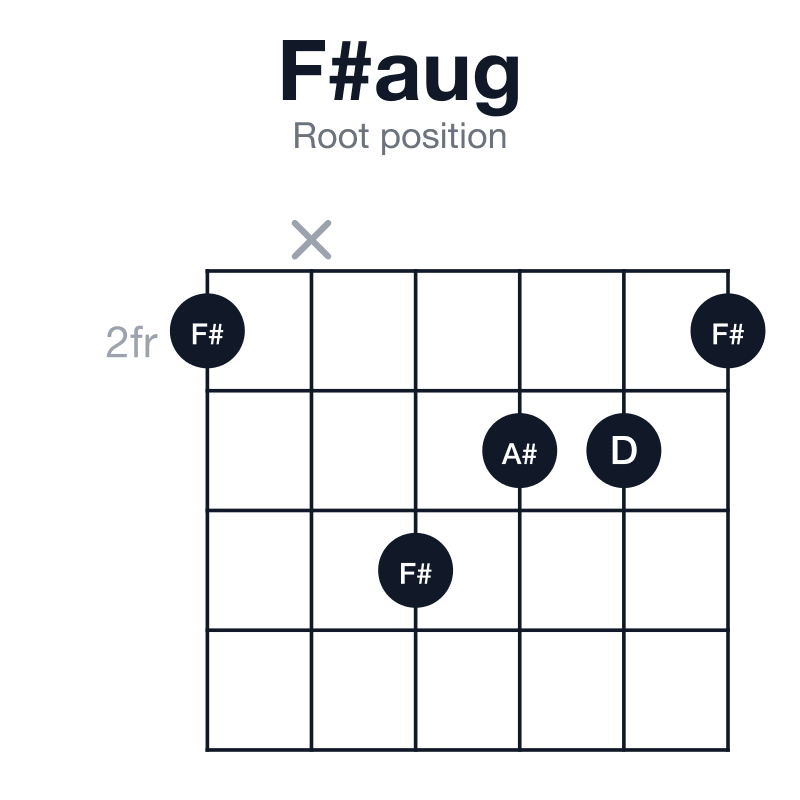
About F#aug — root position
F#aug is F#, A# and D — F# with the fifth raised a semitone.
It sounds stretched, and suspended between keys. Its commonest job is passing between a major triad and its sixth or seventh, with the raised fifth as a single voice walking up.
F#aug notes and formula
| F# | A# | D |
|---|---|---|
| 1 | 3 | ♯5 |
Passing chord — it belongs to no key in particular.
Also written F#+, F#(#5) or F# augmented. The same chord either way; which spelling you meet depends on who wrote the chart.
How to play F#aug
F#aug in root position puts F# in the bass, which is the chord as it is spelled: the note it is named after underneath everything else.
7 of F#aug’s 8 common shapes do this: 2x4332, xx4332, x9877x, x-9-x-11-11-10, x-9-12-11-11-x, x-x-x-11-11-10, 14-13-12-11-11-x.
Start with xx4332 — down at the nut. None of the shapes for F#aug uses an open string, so every one of them is movable; the lowest sits at the 2nd fret. None of them needs a barre. Together they cover the neck from the 2nd fret to the 14th.
| Frets | Where | Bass | Top | Hand |
|---|---|---|---|---|
| 2x4332 | 2nd fret | F#, root position | F# | all fretted |
| xx4332 | 2nd fret | F#, root position | F# | all fretted |
| xx8776 | 6th fret | A#, 1st inversion | A# | all fretted |
| x9877x | 7th fret | F#, root position | F# | all fretted |
| x-9-x-11-11-10 | 9th fret | F#, root position | D | all fretted |
| x-9-12-11-11-x | 9th fret | F#, root position | A# | all fretted |
| x-x-x-11-11-10 | 10th fret | F#, root position | D | all fretted |
| 14-13-12-11-11-x | 11th fret | F#, root position | A# | all fretted |
The same notes rebuilt from scratch give 45 triad voicings, each on its own page.
What to play over F#aug
Every note of F#aug is in F# whole tone and F# altered.
Chords near F#aug
Change one note of F#aug and you have F# (the sharp fifth becomes a fifth), F#maj7#5 (add the major seventh) or F#aug7 (add the flat seventh).
F#aug is a augmented chord — root, major third, sharp fifth. Augmented chords on every root.
On F#aug’s sound and use this page follows Stefan Kostka, Dorothy Payne & Byron Almén, Tonal Harmony (McGraw-Hill, 8th ed., 2018). The shapes and the derived voicings come from different places, and both are explained in where the chords and the theory come from.