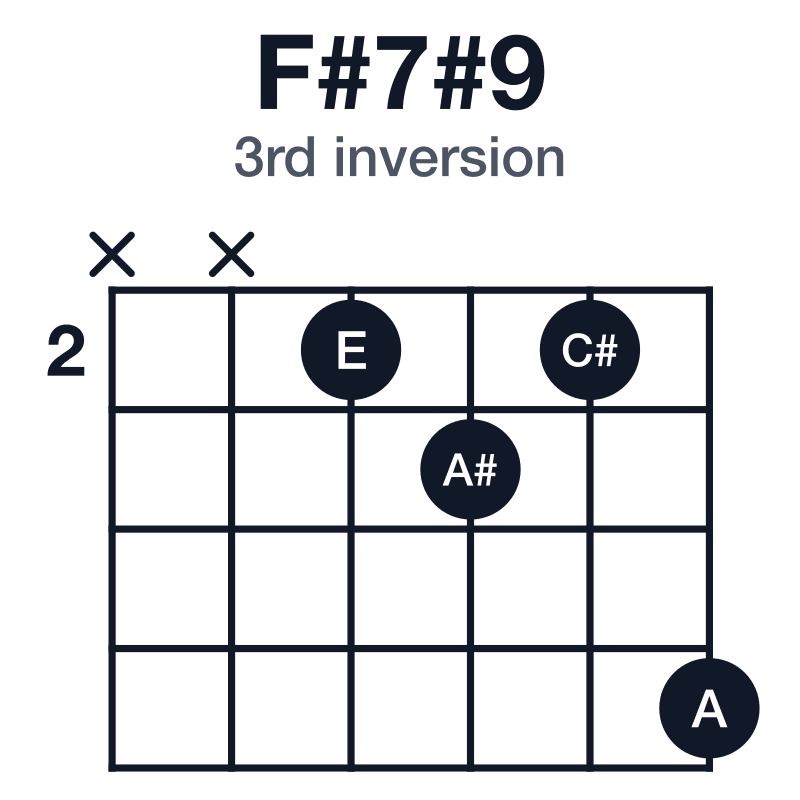
F#7#9 guitar chord

3rd inversion · E in the bass
  • Tap a note to hear it
  • Arrows change position
  • Fingers, notes or intervals
  • Play the chord

About F#7#9 — 3rd inversion

F#7#9 holds the major 3rd and G##♯9 in the same dominant chord: F#, A#, C#, E and G##. The two notes sound a semitone apart.

The major 3rd stays essential. In blues, 7♯9 can stand on the tonic itself as well as lead to another chord.

Also written F#7(#9), F#7+9 or F#7♯9.

F#7#9 3rd inversion guitar chord diagram: F#, A#, C#, E, A, played xx2325
F#7#9 3rd inversion guitar chord voicing: x-x-2-3-2-5.

What 3rd inversion means

F#7#9 in 3rd inversion puts E in the bass instead of F#, the 7th of the chord. The notes are the same; what changes is what the bass line does, which is most of why you would reach for it — it lets the lowest voice move by step where the root would have jumped.

One of F#7#9’s 10 shapes does this:xx2325

How to use F#7#9

1The bluesy tonic

I7 – IV7 – I7 in a blues

F#7#9 can replace a plain seventh chord wherever a bluesy sound is wanted, even as the first chord of a tune, where other altered dominants don’t belong. It sounds like home, with no urge to fall a fifth.

Listen for: The sharp nine, a minor third sounding over the major third, holds through the IV7 as its flat seventh.

Other uses

From the books, without a worked example
  • As an altered V
    V in B major

    Like the other altered dominants, F#7#9 works in front of a chord a fourth higher, such as Bmaj7, a chord a half step lower, or a minor chord on its own root.

    1. F#7#9
    2. Bmaj7

What to play over F#7#9

Useful scales

Every scale

Chords near F#7#9

Remove a note

Change one note

  • 1st inversion
    9th in bass
    A# → G#

    Replace the major third with the ninth.

    See F#m9 chord →
  • 3rd inversion
    3rd inversion
    C# → D

    Raise the fifth to the flat thirteenth.

    See F#alt chord →
  • A → G#

    Lower the sharp ninth to the ninth.

    See F#9 chord →
  • 3rd inversion
    3rd inversion
    A → G

    Replace the sharp ninth with the flat ninth.

    See F#7b9 chord →

Altered dominant chords on every root

The common shapes and the derived voicings come from different places, and both are explained in how this site is built.