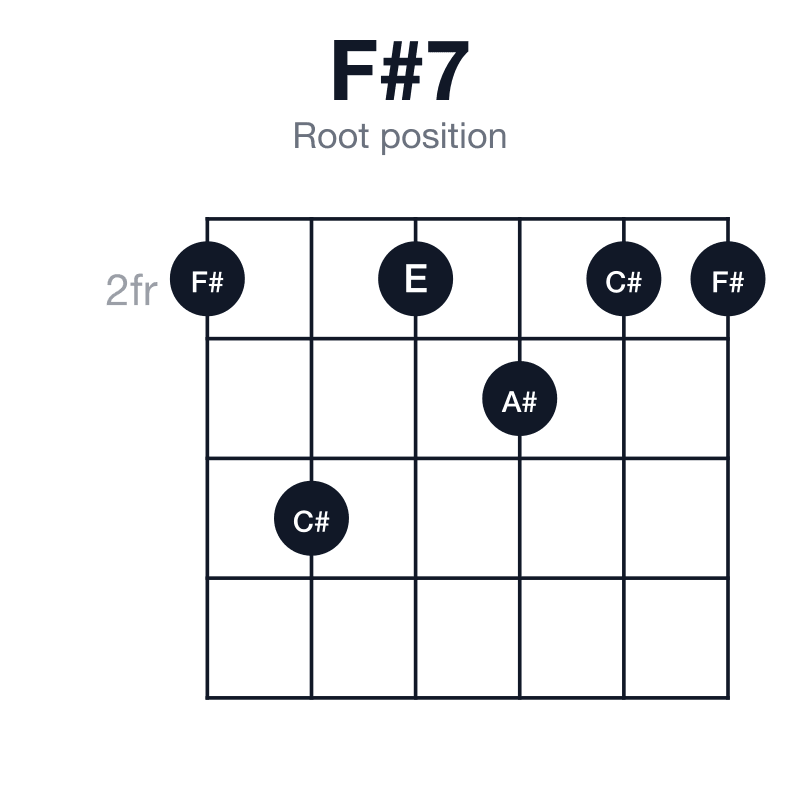
F#7 guitar chord

1 of 5

The standard grips this chord is usually shown with.

  • Tap a note to hear it
  • Arrows change position
  • Fingers, notes or intervals
  • Play the chord
About F#7root position

F#7 is F#, A#, C# and E F# with the flat seventh added on top.

It sounds restless and pointed at something. The third and the flat seventh are a tritone apart and each moves by a semitone into the next chord; that is the engine of a cadence, and the whole vocabulary of the blues.

F#7 root position guitar chord diagram: F#, A#, C#, E, played 242322
F#7 root position, 242322 — the shape above, as a picture.

F#7 notes and formula

Notes and interval formula
F#A#C#E
135♭7

Dominant — it points a fifth down.

Also written F#dom7 or F# dominant 7. The same chord either way; which spelling you meet depends on who wrote the chart.

How to play F#7

F#7 in root position puts F# in the bass, which is the chord as it is spelled: the note it is named after underneath everything else.

5 of F#7’s 6 common shapes do this: 242322, xx4656, x9897x, x-9-11-9-11-9, 14-13-11-11-11-12.

Start with xx4656no barre and low, at the 4th fret. None of the shapes for F#7 uses an open string, so every one of them is movable; the lowest sits at the 2nd fret. 4 of the 6 need a barre. Together they cover the neck from the 2nd fret to the 14th.

Every common shape for F#7
FretsWhereBassTopHand
2423222nd fretF#, root positionF#barred
xx46564th fretF#, root positionA#all fretted
x9897x7th fretF#, root positionF#all fretted
x-9-11-9-11-99th fretF#, root positionC#barred
x-x-11-11-11-1211th fretC#, 2nd inversionEbarred
14-13-11-11-11-1211th fretF#, root positionEbarred

The same notes rebuilt from scratch give 6 shell, 13 drop 2, 9 drop 3 and 6 open string voicings, each on its own page.

Tensions. A shell of F#7, root, third and seventh, leaves a string free, and the tones that belong over it are the b9 (G), the 9 (G#), the #9 (G##), the #11 (B#), the b13 (D) and the 13 (D#).

How to use F#7

F#7 is the V of B, and that is where it goes if it goes anywhere: the third and the flat seventh are a tritone apart, and both resolve by a semitone into B.

Voice by voice, F#7B. 2 voices move by a semitone, and one note is common to both chords.

In F#7MovesIn B
F#, the rootstays where it isF#, the fifth
A#, the major thirdrises a semitoneB, the root
C#, the fifthfalls a whole toneB, the root
E, the flat seventhfalls a semitoneD#, the major third

In which keys. Every note of F#7 belongs to Ab minor (the ♭VII) and B major (the V, the dominant).

What to play over F#7

Every note of F#7 is in F# mixolydian, F# lydian dominant and F# half-whole diminished.

Chords near F#7

Change one note of F#7 and you have F# (drop the flat seventh), F#maj7 (the flat seventh becomes a major seventh), F#m7 (the major third becomes a minor third), F#add9 (the flat seventh becomes a ninth), F#6 (the flat seventh becomes a sixth) or F#7sus4 (the major third becomes a fourth).

F#7 is a dominant chord — root, major third, fifth, minor seventh. Dominant seventh chords on every root.

On F#7’s sound and use this page follows Edward Aldwell & Carl Schachter, Harmony and Voice Leading (Schirmer / Cengage, 4th ed., 2011). The shapes and the derived voicings come from different places, and both are explained in where the chords and the theory come from.

Midi Settings

7.5
Play Style
One pass of the pick from the lowest string up, everything left ringing.
Instrument
350
150

Style

Shows each chord the way this style would voice it, and marks which of its alternatives belong to the idiom.

Layout

Left Handed Mode