F#69 guitar chord
The standard grips this chord is usually shown with.
- Tap a note to hear it
- Arrows change position
- Fingers, notes or intervals
- Play the chord
About F#69 — 6th in bass
F#69 is F#, A#, C#, D# and G# — F#6 with the ninth added as well.
It sounds wide and entirely at rest. The modern way to voice a tonic when a triad is too bare and a maj7 too pointed.
Tonic — it commits to nothing.
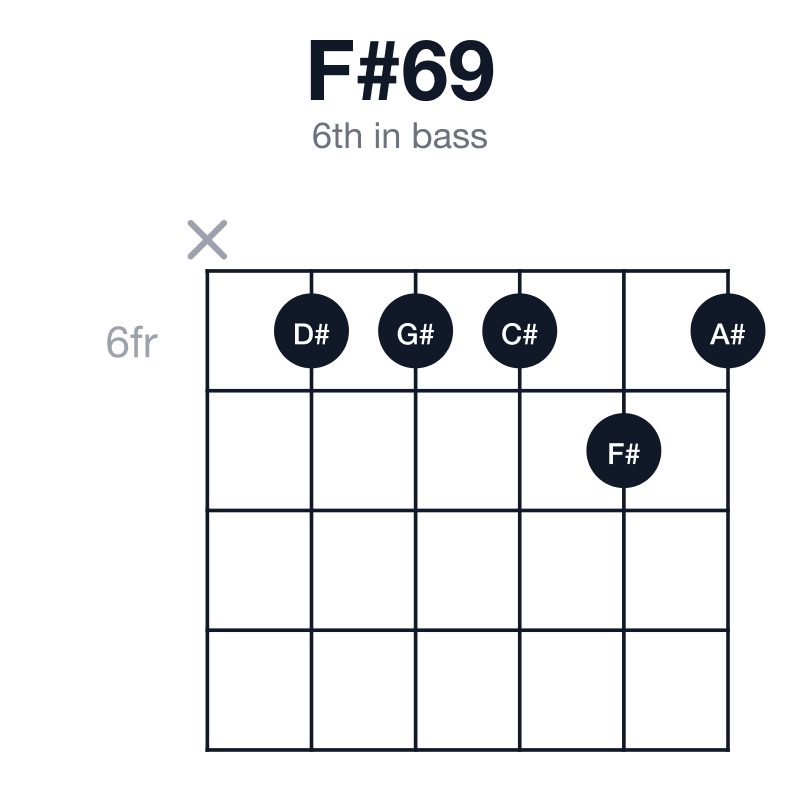
F#69 notes and formula
| F# | A# | C# | D# | G# |
|---|---|---|---|---|
| 1 | 3 | 5 | 6 | 9 |
Also written F#6/9, F#6add9 or F# six nine. The same chord either way; which spelling you meet depends on who wrote the chart.
How to play F#69
F#69 in 6th in bass puts D# in the bass instead of F#, the 6th of the chord. The notes are the same; what changes is what the bass line does, which is most of why you would reach for it — it lets the lowest voice move by step where the root would have jumped.
One of F#69’s 8 common shapes does this:x66676
Play F#69 as a shell — root, third and seventh — and the spare string takes the #11 (B#).
All 8 common shapes as fret numbers, lowest string first. Hover or tap one to see it drawn.
- 211122, 1st fret, F#, root position, top note F#, barred
- xx4344, 3rd fret, F#, root position, top note G#, barred
- x44344, 3rd fret, C#, 2nd inversion, top note G#, barred
- x66676, 6th fret, D#, 6th in the bass, top note A#, barred
- x96876, 6th fret, F#, root position, top note A#, all fretted
- x98899, 8th fret, F#, root position, top note C#, barred
- x-11-11-11-11-11, 11th fret, G#, 9th in the bass, top note D#, barred
- 14-13-13-13-14-14, 13th fret, F#, root position, top note F#, barred
How to use F#69
How you get to it. The turn that lands on F#69 is G#m7 to C#7 — the ii and the V of F# — and C#7 shares its third and seventh with G#m7, so the hand barely moves between them.
In which keys. Every note of F#69 belongs to C# major (the IV), Eb minor (the ♭III), F# major (the I), Ab minor (the ♭VII), Bb minor (the ♭VI) and B major (the V).
What to play over F#69
F#69 is every note of the F# major pentatonic, and nothing else. It also sits inside F# major, F# lydian, F# mixolydian and F# lydian dominant.
Chords near F#69
Change one note of F#69 and you have F#maj9 (the sixth becomes the major seventh), F#maj13 (add the major seventh), F#m69 (the major third becomes the minor third), F#add9 (drop the sixth), F#6 (drop the ninth) or F#9 (the sixth becomes the flat seventh).
F#69 is a major chord — root, major third, fifth. Major chords on every root.
The common shapes and the derived voicings come from different places, and both are explained in how this site is built.