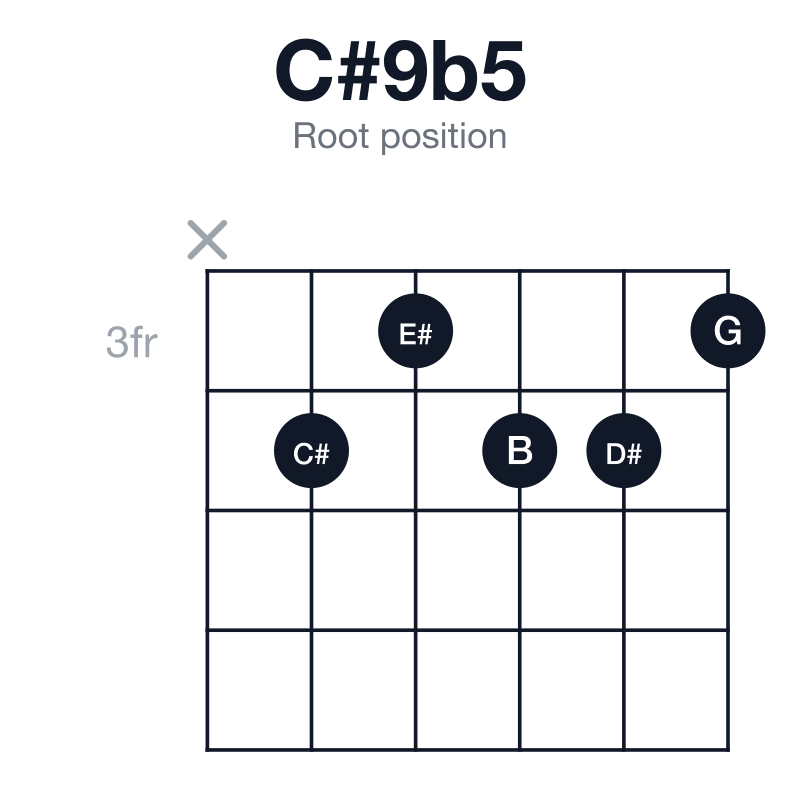
C#9b5 guitar chord
- Tap a note to hear it
- Arrows change position
- Fingers, notes or intervals
- Play the chord
About C#9b5 — root position
C#9b5 keeps the natural 9th of , but lowers its 5th to : C#, E#, G, B and D#.
Keep the flat 5th audible. C#9b5 is not with a flat 9th; the 9th is still natural.
Also written C#9(b5), C#9-5 or C#9♭5.
What root position means
C#9b5 in root position puts C# in the bass, which is the chord as it is spelled: the note it is named after underneath everything else.
4 of C#9b5’s 8 shapes do this:x434439898899-10-x-10-0-119-10-9-10-x-11
How to use C#9b5
C#9b5 is a dominant with its tension raised, so it still points at — harder than a plain seventh does. A plain dominant has two voices a semitone from home; an altered one has four, because every altered tone is also sitting a semitone from a note of F#. More voices leaning the same way is all "more tension" means here.
In a phrase:→→
The ii–V–I of F#.
Voice by voice, C#9b5 → . 3 voices move by a semitone, and one note is common to both chords. Those semitones are what the ear follows; the rest is the chord rearranging itself underneath.
| In C#9b5 | Moves | In F# |
|---|---|---|
| C#, the root | stays where it is | C#, the fifth |
| E#, the major third | rises a semitone | F#, the root |
| G, the flat fifth | falls a semitone | F#, the root |
| B, the flat seventh | falls a semitone | A#, the major third |
| D#, the ninth | falls a whole tone | C#, the fifth |
What to play over C#9b5
Useful scales
- +A
Contains C#9b5 and adds sharp fifth.
- +G#A#
Adds fifth and thirteenth, for a dominant sharp-eleventh color.
Chords near C#9b5
Remove a note
Change one note
3rd inversion 3rd inversion
The common shapes and the derived voicings come from different places, and both are explained in how this site is built.