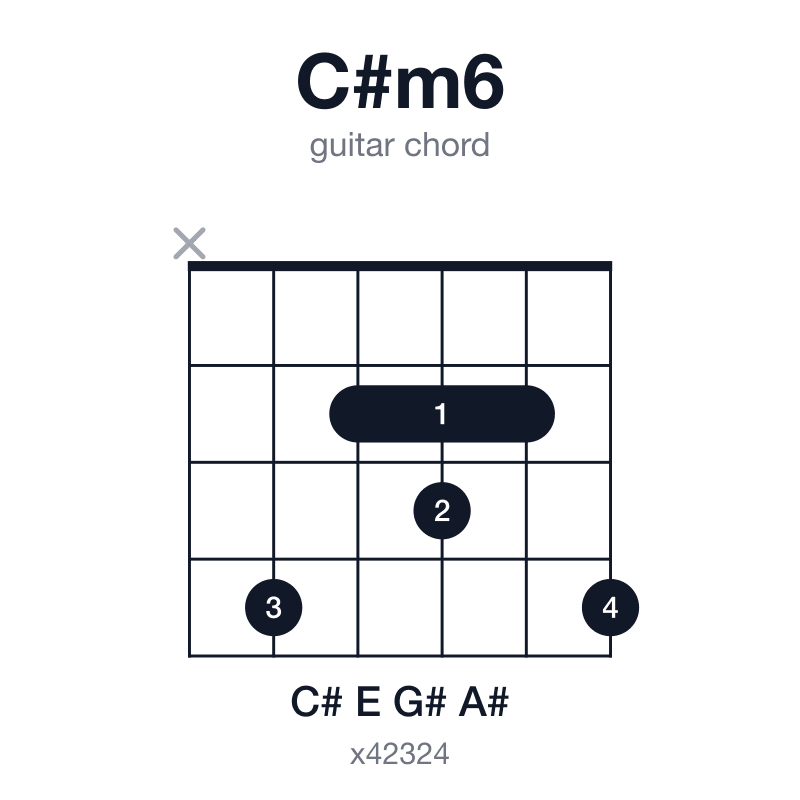
C#m6 guitar chord

1 of 4
  • Tap a note to hear it
  • Arrows change position
  • Fingers, notes or intervals
  • Play the chord

About C#m6

C#m6 is C#, E, G# and A#. Start with and add the .

The “6” means , a major 6th above . That note separates C#m6 from , which uses the instead.

To hear the difference, compare with C#m6.

Hear the change

The flat 7th falls one fret to the 6th. The root, minor 3rd, and 5th stay the same.

When is the home chord, jazz players often use C#m6 instead of . The minor triad stays intact. The choice is or .

Also written C#min6, C#-6 or C# minor 6.

C#m6 guitar chord diagram: C#, E, G#, A#, played 9x8999
C#m6 guitar chord voicing: 9-x-8-9-9-9.

How to use C#m6

1Home base in a minor key

i in C♯ minor

C#m6 is where a minor tune comes to rest — a minor I, never a ii. It is the natural landing chord of a minor ii–V–i.

Try it with

Listen for: The flat nine on top of the dominant falls a half step onto the fifth.

Works when the minor chord is a destination — not a ii leading straight into its own V.

Heard in“Summertime”“Blue Bossa”“Invitation”

2The line cliché

i in C♯ minor

Hold a minor chord for a few bars and walk one voice down from the root, a half step at a time. C#m6 is the last step.

Listen for: Only one note moves: root, major seventh, flat seventh, sixth.

Heard in“Manhã de Carnaval”“’Round Midnight”“My Funny Valentine”

3Borrowed into a major key

iv in A♭ major

In A♭ major, C#m6 is the iv chord borrowed from the parallel minor. Slip it between two tonic chords and the bar darkens, then slides straight home.

Compare with

Listen for: The minor third falls a half step to the tonic’s fifth — the note a major IV does not have.

4One shape, three chords

change the bass

Hold this C#m6 chord shape still and move only the bass: over the sixth it becomes A#m7b5, over the fourth it becomes F#9. Wherever a chart asks for either, you already know the shape.

Listen for: Only the bass moves, down in thirds. The four notes above it never change, yet each bass names a different chord.

Heard inJim Hall’s comping on “My Funny Valentine”, from Undercurrent

Other uses

From the books, without a worked example
  • A new quality in the next bar
    i in C♯ minor

    When a minor ii–V lands on a i that lasts two bars, the i can change quality instead of sitting still: C#mMaj7, then C#m6, melody permitting. The harmony seems to move every bar.

    1. D#m7b5
    2. G#alt
    3. C#mMaj7
    4. C#m6

    Heard in “Autumn Leaves” (end of the A section)

  • The first chord of a minor turnaround
    i in C♯ minor

    The basic turnaround in C♯ minor can start on C#m6 as well as on the minor seventh.

    1. C#m6
    2. A#m7b5
    3. D#m7b5
    4. G#alt
  • Reached from the IV7
    i in C♯ minor

    C#m6 can be reached from F#7 rather than from its V, a plagal cadence. The ♭VI7 can take the IV7’s place, and so can the dominant a half step below C#m6.

    1. C#m6
    2. F#7
    3. C#m6
  • With passing diminished chords
    harmonising a melody

    A melody can be harmonised by alternating C#m6 with diminished seventh chords, the minor form of the sixth–diminished sound.

    Heard in “Softly, as in a Morning Sunrise” (first five bars)Go to the C#6 page to hear it →

In which keys. Every note of C#m6 belongs to Ab minor and B major.

What to play over C#m6

Useful scales

  • +D#F#B

    Contains C#m6 and adds second, fourth and flat seventh.

  • +D#F#B#

    Contains C#m6 and adds second, fourth and major seventh.

  • +DE#GB

    Contains C#m6 and adds flat second, major third, sharp eleventh and flat seventh.

Every scale

Chords near C#m6

Change one note

  • 2nd inversion
    2nd inversion
    G# → G

    Lower the fifth to the flat fifth.

    See C#dim7 chord →
  • 6th in bass
    3rd inversion
    A# → B

    Raise the sixth to the flat seventh.

    See C#m7 chord →
  • 6th in bass
    3rd inversion
    A# → B#

    Replace the sixth with the major seventh.

    See C#mMaj7 chord →
  • 2nd inversion
    2nd inversion
    E → E#

    Raise the minor third to the major third.

    See C#6 chord →

Minor chords on every root

The common shapes and the derived voicings come from different places, and both are explained in how this site is built.

Midi Settings

7.5
Play Style
One pass of the pick from the lowest string up, everything left ringing.
Instrument
350
150

Style

Shows each chord the way this style would voice it, and marks which of its alternatives belong to the idiom.

Layout

Left Handed Mode