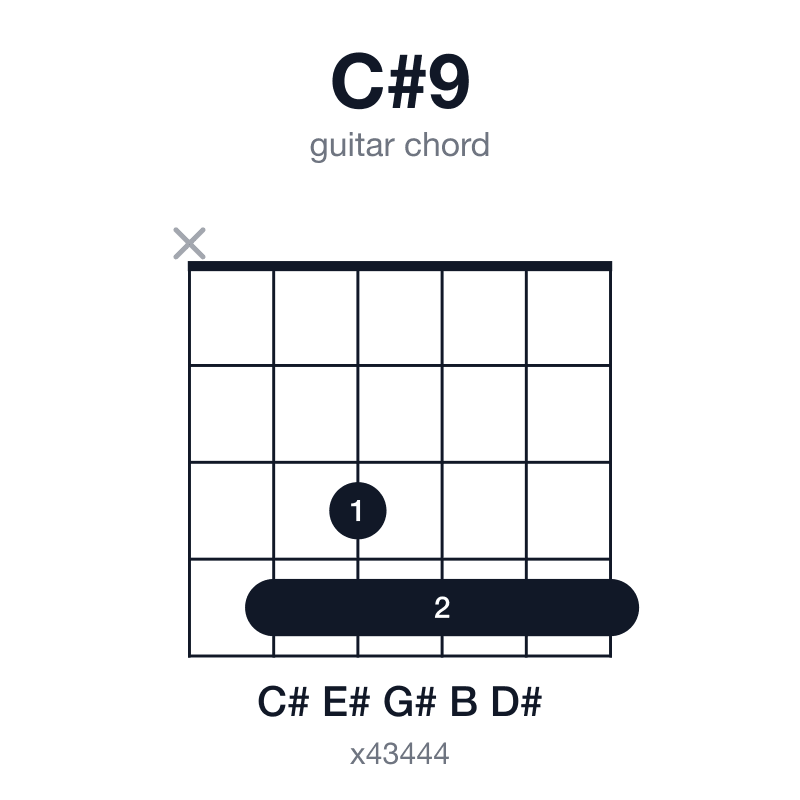
The standard grips this chord is usually shown with.
C#9 is C#, E#, G#, B and D#, a dominant ninth. The shape this page opens on is written x43444, lowest string first.

Also written C#dom9 or C# dominant 9. The same chord either way; which spelling you meet depends on who wrote the chart.
There are 8 common shapes for C#9 on the guitar, and 36 derived voicings in 4 families.
In which keys. Every note of C#9 belongs to Eb minor (the ♭VII) and F# major (the V).
The common shapes, written lowest string first: x43444, x66667, 966867, 9898xx, 9-11-9-8-9-11, 9-11-9-10-9-11, x-x-11-10-12-11, 13-x-11-13-12-11.
Shell. Root, third and seventh: the guide tones fix the quality, so the fifth is dropped. That is what leaves a string free, so pick a tension to put on top. C#9 has x4344x, 9898xx, x-x-11-10-12-11.
Drop 2. A close-position chord with the second voice from the top lowered an octave. Sits on four adjacent strings. C#9 has x4344x, 9898xx, x-x-11-10-12-11, 1414xx, xx1421, xx3647, 7636xx, x6966x.
Drop 3. The third voice from the top lowered an octave. The dropped voice becomes the bass, which is why a string is skipped. C#9 has x4x441, 1x142x, 7x364x, x6x667, 9x986x, x-8-x-8-12-9, 11-x-11-10-12-x, x-14-x-10-14-11.
Rootless. The root left to the bass player. Frees a finger for a tension. C#9 has xx1101, xx3444, x6646x, xx6867, x8989x, x-x-9-10-9-11, x-x-13-13-12-13, x2314x.
Tensions. A shell of C#9, root, third and seventh, leaves a string free, and the tones that belong over it are the #11 (F##), the b13 (A) and the 13 (A#).
The common shapes and the derived voicings come from different places, and both are explained in where the chords and the theory come from.
Shows each chord the way this style would voice it, and marks which of its alternatives belong to the idiom.