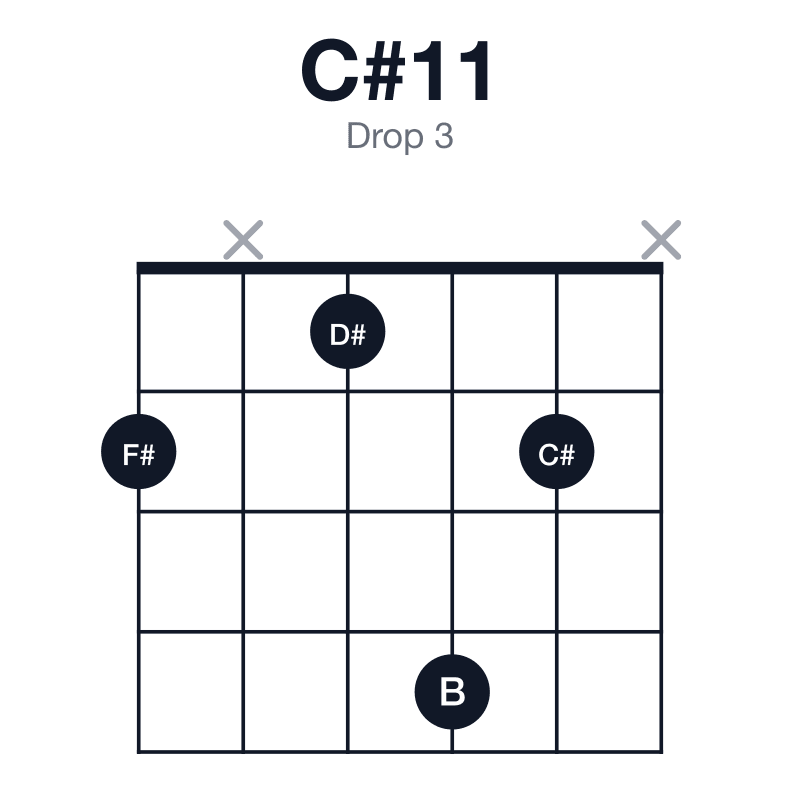
The third voice from the top lowered an octave. The dropped voice becomes the bass, which is why a string is skipped.
C#11 is C#, G#, B, D# and F# — C#9 with the eleventh added, and the third usually dropped.
It sounds suspended rather than tense. The eleventh sits a semitone above the major third, so the third is usually dropped; some shapes here keep it anyway.
Dominant — but effectively a sus chord with a ninth.

| C# | G# | B | D# | F# |
|---|---|---|---|---|
| 1 | 5 | ♭7 | 9 | 11 |
Also written C#9sus4 or C# dominant 11. The same chord either way; which spelling you meet depends on who wrote the chart.
The same operation one voice further down: the third voice from the top falls an octave and becomes the bass.
That leaves a bigger hole under the top three notes, so a string gets skipped: the muted string in the middle is the shape, not a mistake.
C#11 has 16 of them, on strings 6-4-3-2 and strings 5-3-2-1, from open position up to the 11th — every inversion the chord has: C# in the bass, G# in the bass, B in the bass, D# in the bass and F# in the bass. The one to learn first is the F# shape at the nut.
8 of them sit on strings 6-4-3-2, so you can run the inversions up one set without changing strings — which is the whole reason to learn them as a family rather than as separate grips.
Five notes and four fingers, so something has to go. Keep D#, F# and B (they fix the quality). Let G# and C# go, in that order — a perfect fifth says nothing the root has not, and in a band the bass has the root.
All 6 common shapes as fret numbers, lowest string first. Hover or tap one to see it drawn.
C#11 is the V of F#, and that is where it goes if it goes anywhere: the third and the flat seventh are a tritone apart, and both resolve by a semitone into F#.
In a phrase:G#m7→C#11→F#maj7— the ii–V–I of F#.
Voice by voice, C#11 → F#. One voice moves by a semitone, and 2 notes are common to both chords.
| In C#11 | Moves | In F# |
|---|---|---|
| C#, the root | stays where it is | C#, the fifth |
| G#, the fifth | falls a whole tone | F#, the root |
| B, the flat seventh | falls a semitone | A#, the major third |
| D#, the ninth | falls a whole tone | C#, the fifth |
| F#, the eleventh | stays where it is | F#, the root |
In which keys. Every note of C#11 belongs to C# minor (the i), Eb minor (the ♭VII), E major (the vi), F# major (the V), Ab minor (the iv) and B major (the ii).
Every note of C#11 is in C# mixolydian, C# dorian and C# natural minor.
Change one note of C#11 and you have C#sus2sus4 (drop the flat seventh), C#m9 (the eleventh becomes the minor third), C#m11 (add the minor third), C#7sus4 (drop the ninth) or C#9 (the eleventh becomes the major third).
C#11 is a dominant chord — root, major third, fifth, minor seventh. Dominant seventh chords on every root.
The common shapes and the derived voicings come from different places, and both are explained in how this site is built.
Shows each chord the way this style would voice it, and marks which of its alternatives belong to the idiom.