The third voice from the top lowered an octave. The dropped voice becomes the bass, which is why a string is skipped.
Amaj7b5 is A, C#, Eb and G# — Amaj7 with the fifth lowered a semitone.
It sounds hollow and hard to place. Far more often met spelled the other way round, as a ♯11 over a chord that kept its fifth.

| A | C# | Eb | G# |
|---|---|---|---|
| 1 | 3 | ♭5 | 7 |
Coloured tonic — rare, and unstable for a major chord.
Also written AM7b5, AΔ7b5 or Amaj7(b5). The same chord either way; which spelling you meet depends on who wrote the chart.
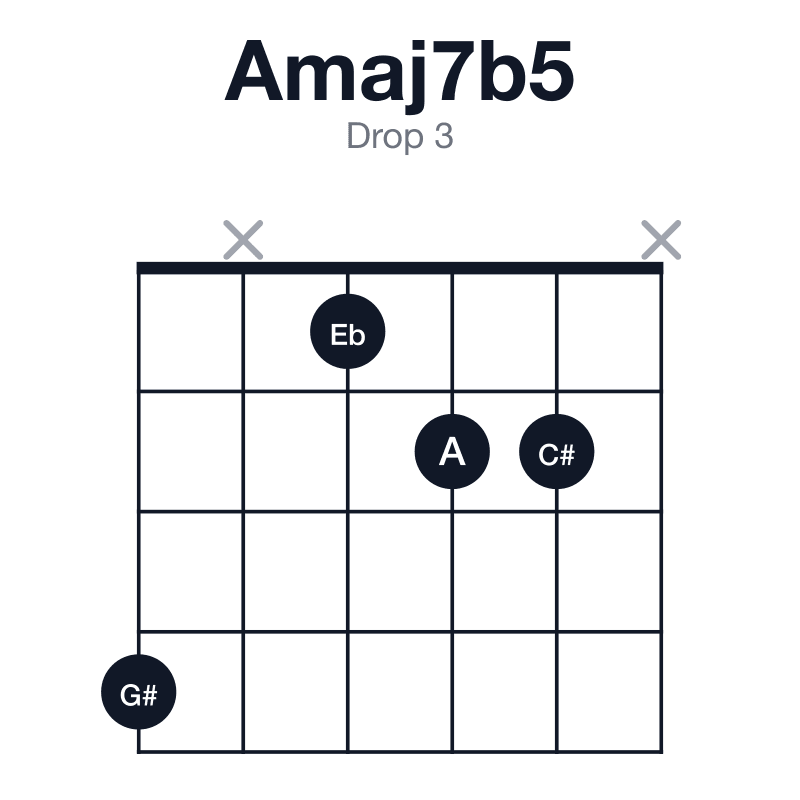
The same operation one voice further down: the third voice from the top falls an octave and becomes the bass.
That leaves a bigger hole under the top three notes, so a string gets skipped: the muted string in the middle is the shape, not a mistake.
Amaj7b5 has 8 of them, on strings 6-4-3-2 and strings 5-3-2-1, from open position up to the 11th — every inversion the chord has: A in the bass, C# in the bass, Eb in the bass and G# in the bass. The one to learn first is the G# shape at the nut.
4 of them sit on strings 6-4-3-2, so you can run the inversions up one set without changing strings — which is the whole reason to learn them as a family rather than as separate grips.
Start with x01124 — no barre and 1 open string. 2 of the 7 shapes here sit in open position. 2 of the 7 need a barre. Together they cover the neck from the 1st fret to the 14th.
| Frets | Where | Bass | Top | Hand |
|---|---|---|---|---|
| x01124 | open position | A, root position | G# | 1 open string |
| x01224 | open position | A, root position | G# | 1 open string |
| 546644 | 4th fret | A, root position | G# | barred |
| 5666x5 | 5th fret | A, root position | A | barred |
| xx7899 | 7th fret | A, root position | C# | all fretted |
| x-12-11-13-14-11 | 11th fret | A, root position | Eb | all fretted |
| x-12-13-13-14-x | 12th fret | A, root position | C# | all fretted |
The same notes rebuilt from scratch give 5 shell, 13 drop 2 and 1 open string voicings, each on its own page.
Tensions. A shell of Amaj7b5, root, third and seventh, leaves a string free, and the tones that belong over it are the 9 (B) and the 13 (F#).
How you get to it. The turn that lands on Amaj7b5 is Bm7 to E7 — the ii and the V of A — and E7 shares its third and seventh with Bm7, so the hand barely moves between them.
In which keys. Every note of Amaj7b5 belongs to C# minor (the ♭VI) and E major (the IV, the subdominant).
Every note of Amaj7b5 is in A lydian.
Change one note of Amaj7b5 and you have Amaj7 (the flat fifth becomes a fifth), Amaj7#5 (the flat fifth becomes a sharp fifth), AmMaj7b5 (the major third becomes a minor third), A7b5 (the major seventh becomes a flat seventh) or A/G# (the flat fifth becomes a fifth).
Amaj7b5 is a major chord — root, major third, fifth. Major chords on every root.
On Amaj7b5’s sound and use this page follows Robert Rawlins & Nor Eddine Bahha, Jazzology (Hal Leonard, 2005). The shapes and the derived voicings come from different places, and both are explained in where the chords and the theory come from.
Shows each chord the way this style would voice it, and marks which of its alternatives belong to the idiom.