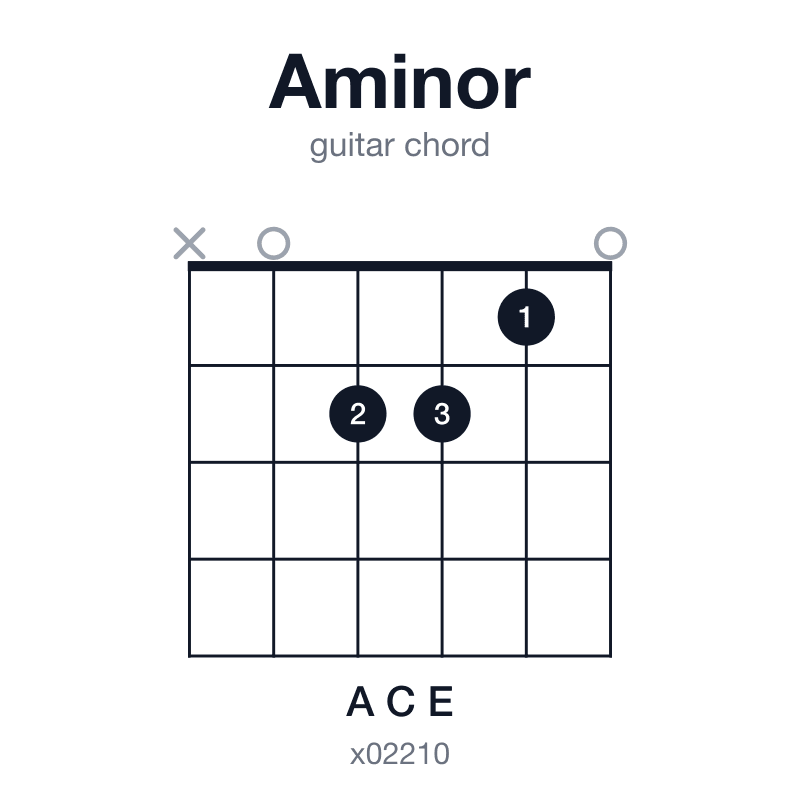
A Minor guitar chord

1 of 5
  • Tap a note to hear it
  • Arrows change position
  • Fingers, notes or intervals
  • Play the chord
  • Dashed note is sometimes omitted

About Am

Am is A, C and E. The is the note that makes the triad minor.

uses the major 3rd instead. To hear the difference, lower that note one fret and let become Am.

Hear the change

The major third falls by one fret to become the minor third. Every other note stays the same.

In rock and pop, Am often sits at home in a two-chord vamp with , the major chord a fourth higher.

Also written Amin, A- or A minor.

Am guitar chord diagram: A, C, E, played x02210
Am guitar chord voicing: x-0-2-2-1-0.

How to use Am

1The dorian i–IV vamp

i in A minor

Rock and pop often rock back and forth between Am and D. The IV is major because the tune is dorian, a minor scale with a raised sixth; make it minor and the sound turns darker, plain minor.

Compare with

Listen for: The fifth rises a whole step to the raised sixth and back. On the minor iv it rises only a half step.

Heard in“Love Is Blue”“Keep Searchin’” (coda)“Soul Kitchen”

2A third below the I

vi in C major

Am is the vi of C major, a third below the I, and shares two of its notes. Keep falling in thirds, C, Am, F, Dm, and above the bass only one note changes at each step, until G closes the phrase.

Listen for: The bass falls a third at a time. Above it one note changes per chord, each a step up: the key’s fifth to its sixth, third to fourth, tonic to second.

Heard in“Johnny Angel”

Other uses

From the books, without a worked example
  • A minor v
    v in D minor

    A minor-key song can cadence on Am, a minor v, instead of the usual major V. With no leading tone the key sounds aeolian rather than minor.

    1. Am
    2. Dm

    Go to the A page to hear it →

  • In place of the I
    iii in F major

    Am, a third above F, can stand in for it. The two share two notes, so the harmony stays the same and only its colour changes.

    1. F
    2. Am

    Heard in “Both Sides Now”

In which keys. Every note of Am belongs to C major, D minor, E minor, F major, G major and A minor.

What to play over Am

Useful scales

  • +DG

    Contains Am and adds fourth and flat seventh.

  • +DEbG

    Contains Am and adds fourth, sharp eleventh and flat seventh.

  • +BDFG

    Contains Am and adds second, fourth, flat thirteenth and flat seventh.

  • +BDF#G

    Contains Am and adds second, fourth, sixth and flat seventh.

  • +BbDFG

    Contains Am and adds flat second, fourth, flat thirteenth and flat seventh.

Every scale

Chords near Am

Change one note

  • open strings
    open strings
    C → C#

    Raise the minor third to the major third.

    See A chord →
  • 1st inversion
    1st inversion
    E → Eb

    Lower the fifth to the flat fifth.

    See Adim chord →
  • open strings
    open strings
    C → B

    Lower the minor third to the second.

    See Asus2 chord →
  • open strings
    open strings
    C → D

    Replace the minor third with the fourth.

    See Asus4 chord →

Add a note

Minor chords on every root

The common shapes and the derived voicings come from different places, and both are explained in how this site is built.

Midi Settings

7.5
Play Style
One pass of the pick from the lowest string up, everything left ringing.
Instrument
350
150

Style

Shows each chord the way this style would voice it, and marks which of its alternatives belong to the idiom.

Layout

Left Handed Mode