Ebaug7 guitar chord
- Tap a note to hear it
- Arrows change position
- Fingers, notes or intervals
- Play the chord
About Ebaug7 — drop 2 voicings
Ebaug7 is Eb, G, B and Db. Start with and raise the 5th from to . You’ll also see this chord written Eb7♯5 or Eb7(♯5).
Hear that one-note change by comparing with Ebaug7.
Hear the change
Only the 5th changes: B♭ rises a half step to B. The other notes stay in place.
When Ebaug7 resolves to , that can rise another half step to .
Also written Eb7#5, Eb+7 or Eb7(#5).
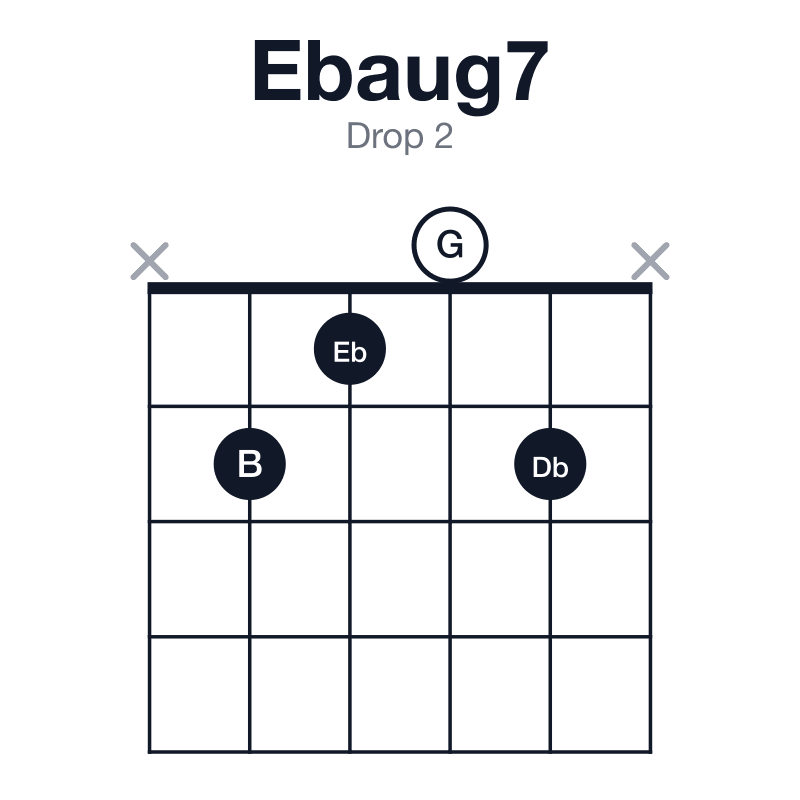
What is drop 2
Stack the four notes closely, then drop the second voice from the top an octave. It typically lands on four adjacent strings: the guitar’s workhorse voicing.
That result, 5–R–3–7, is the shape usually meant by drop 2. Named by its bass note, as the inversions are here, it is the 2nd inversion.
How to use Ebaug7
Ebaug7 is a dominant with its tension raised, so it still points at — harder than a plain seventh does. A plain dominant has two voices a semitone from home; an altered one has four, because every altered tone is also sitting a semitone from a note of Ab. More voices leaning the same way is all "more tension" means here.
In a phrase:→→
The ii–V–I of Ab.
Voice by voice, Ebaug7 → . 3 voices move by a semitone, and one note is common to both chords. Every voice that moves at all moves by a semitone — the shortest distance there is, which is why the change sounds settled rather than sudden.
| In Ebaug7 | Moves | In Ab |
|---|---|---|
| Eb, the root | stays where it is | Eb, the fifth |
| G, the major third | rises a semitone | Ab, the root |
| B, the sharp fifth | rises a semitone | C, the major third |
| Db, the flat seventh | falls a semitone | C, the major third |
What to play over Ebaug7
Useful scales
- +FA
Contains Ebaug7 and adds ninth and flat fifth.
- +FbF#A
Contains Ebaug7 and adds flat ninth, sharp ninth and flat fifth.
Chords near Ebaug7
Change one note
Add a note
The common shapes and the derived voicings come from different places, and both are explained in how this site is built.