C#m9 guitar chord

3rd inversion · B in the bass
  • Tap a note to hear it
  • Arrows change position
  • Fingers, notes or intervals
  • Play the chord

About C#m9 — 3rd inversion

C#m9 is C#, E, G#, B and D#. It keeps every note of and adds the .

In a ii–V, use C#m9 in place of when you want the 9th included.

Unlike , C#m9 keeps the already found in .

To hear the 9th, compare with C#m9.

Hear the change

One repeated root rises two frets to the 9th. Every other note stays the same.

Also written C#min9, C#-9 or C# minor 9.

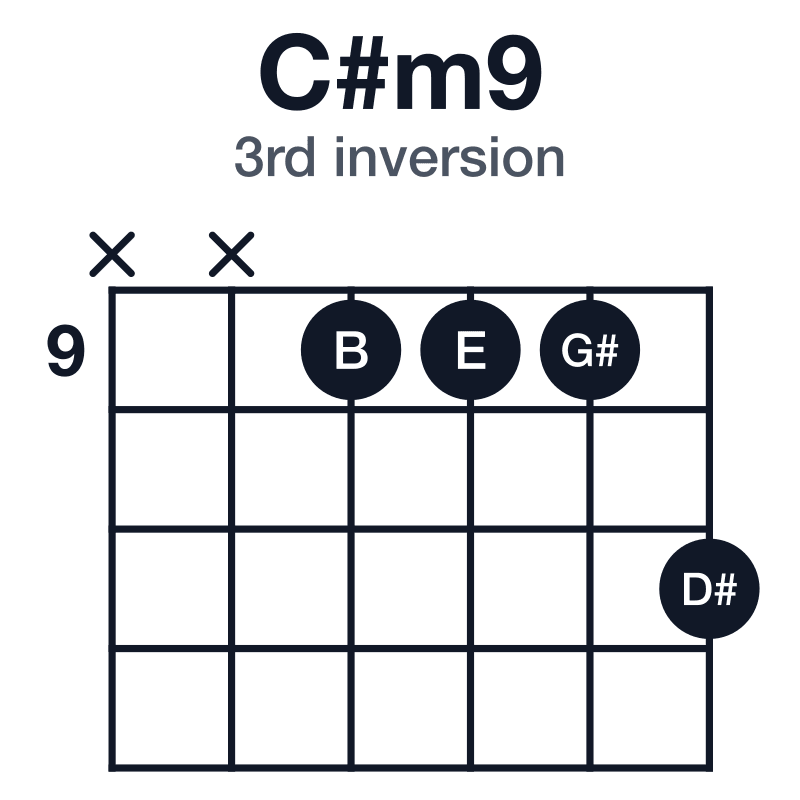
C#m9 3rd inversion guitar chord diagram: C#, E, G#, B, D#, played x-x-9-9-9-11
C#m9 3rd inversion guitar chord voicing: x-x-9-9-9-11.

What 3rd inversion means

C#m9 in 3rd inversion puts B in the bass instead of C#, the 7th of the chord. The notes are the same; what changes is what the bass line does, which is most of why you would reach for it — it lets the lowest voice move by step where the root would have jumped.

One of C#m9’s 15 shapes does this:x-x-9-9-9-11

How to use C#m9

1The ii of an extended ii–V–I

ii in B major

Jazz players rarely leave a ii–V–I as bare sevenths: C#m9, F#13, Bmaj9. The ninth on top of the ii is already the V’s thirteenth, so it holds over the barline before falling a step to the ninth of the I.

Compare with

Listen for: The ninth holds as the V’s thirteenth, then falls a whole step. On the plain m7 that string starts on the root and has to climb.

2A maj7 with a new bass

vi in E major

Leave the root off C#m9 and the four notes left are Emaj7. So the I can turn into the vi without moving a finger above the bass, a tonic swap jazz players make freely.

Listen for: Nothing above moves. A bass note arrives a minor third below the I’s root, and the chord is minor.

In which keys. Every note of C#m9 belongs to C# minor, E major, Ab minor and B major.

What to play over C#m9

Useful scales

  • +F#A

    Contains C#m9 and adds eleventh and flat thirteenth.

  • +F#A#

    Contains C#m9 and adds eleventh and thirteenth.

Every scale

Chords near C#m9

Remove a note

Change one note

Add a note

Minor chords on every root

The common shapes and the derived voicings come from different places, and both are explained in how this site is built.