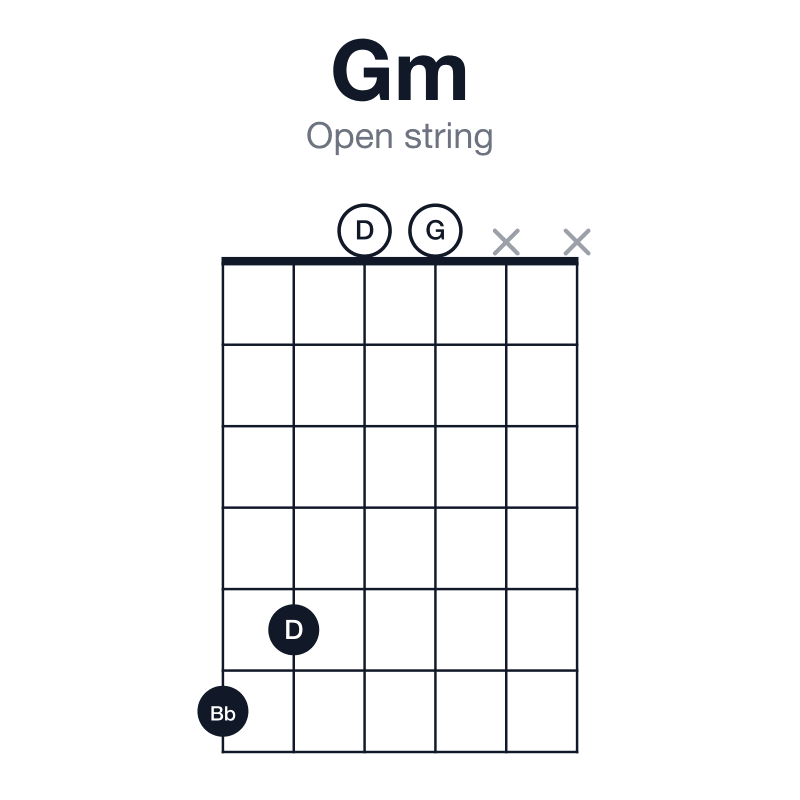
G Minor guitar chord

Open string · strings 6543 · 1st inversion1 of 3

An open string left ringing against a fretted grip. Because it costs no finger, it sounds a note the closed shape has none left for -- a tension on top, or a pedal root underneath. Either a familiar grip with open strings added, or a shape so sparse the open strings carry the chord. These belong to their key rather than to a shape, so D, A, G and E have many and Eb a handful.

Inversion
  • Tap a note to hear it
  • Arrows change position
  • Fingers, notes or intervals
  • Play the chord
About Gmopen string voicings

Gm is G, Bb and D G with the third lowered a semitone.

It sounds darker than a major triad, and just as settled. The i of a minor key, and the vi, ii or iii of a major one.

Gm open string guitar chord diagram: G, Bb, D, played 6500xx
Gm open string, 6500xx — the shape above, as a picture.

Gm notes and formula

Notes and interval formula
GBbD
1♭35

Tonic — minor chords rest as readily as major ones.

Also written Gmin, G- or G minor. The same chord either way; which spelling you meet depends on who wrote the chart.

How to play Gm

Open-string voicing
×EADGBE

An open string left ringing against a fretted grip. It costs no finger, so it can sound a note the closed shape has none left for: a tension on top, or a pedal root underneath.

These belong to their key rather than to a shape: they cannot be moved up the neck. D, A, G and E have many; E♭ has a handful.

Gm has 3 of them, on the bottom four strings, the top four strings and strings 6-4-3-2, from the 3rd fret up to the 5thevery inversion the chord has: Bb in the bass and D in the bass. The one to learn first is the Bb shape at the 5th fret, which is the easiest grip here.

Start with xx5786no barre and low, at the 5th fret. 1 of the 9 shapes here sits in open position. 3 of the 9 need a barre. Together they cover the neck from the 1st fret to the 15th.

Every common shape for Gm
FretsWhereBassTopHand
310033open positionG, root positionGbarred
3553333rd fretG, root positionGbarred
xx53333rd fretG, root positionGbarred
xx57865th fretG, root positionBball fretted
xx87866th fretBb, 1st inversionBball fretted
x-10-8-7-8-x7th fretG, root positionGall fretted
x-10-12-12-11-1010th fretG, root positionDall fretted
x-13-12-12-11-x11th fretBb, 1st inversionBball fretted
15-13-12-12-x-1512th fretG, root positionGall fretted

The same notes rebuilt from scratch give 48 triad voicings, each on its own page.

How to use Gm

How you get to it. The turn that lands on Gm is Am7♭5 to D7♭9: the ii and the V of G minor, which is where a minor tonic is usually arrived at rather than simply begun on.

In which keys. Every note of Gm belongs to C minor (the v), D minor (the iv), Eb major (the iii), F major (the ii), G minor (the i) and Bb major (the vi).

What to play over Gm

Every note of Gm is in G minor pentatonic, G blues, G dorian, G natural minor and G phrygian.

Chords near Gm

Change one note of Gm and you have G (the minor third becomes a major third), Gdim (the fifth becomes a flat fifth), Gsus2 (the minor third becomes a ninth), Gsus4 (the minor third becomes a fourth), Gm6 (add the sixth) or Gm7 (add the flat seventh).

Gm is a minor chord — root, minor third, fifth. Minor chords on every root.

On Gm’s sound and use this page follows Edward Aldwell & Carl Schachter, Harmony and Voice Leading (Schirmer / Cengage, 4th ed., 2011). The shapes and the derived voicings come from different places, and both are explained in where the chords and the theory come from.

Midi Settings

7.5
Play Style
One pass of the pick from the lowest string up, everything left ringing.
Instrument
350
150

Style

Shows each chord the way this style would voice it, and marks which of its alternatives belong to the idiom.

Layout

Left Handed Mode