Gmaj7b5 guitar chord
- Tap a note to hear it
- Arrows change position
- Fingers, notes or intervals
- Play the chord
About Gmaj7b5 — drop 2 voicings
Gmaj7b5 is G, B, Db and F#. It keeps the major 3rd and 7th of , but lowers the 5th one fret to the .
The flat 5th replaces the natural 5th. A maj7 sharp 11 chord keeps the natural 5th and adds the sharp 11. The names are not interchangeable.
Keep the flat 5th audible. Without it, the remaining notes only spell .
Also written GM7b5, GΔ7b5 or Gmaj7(b5).
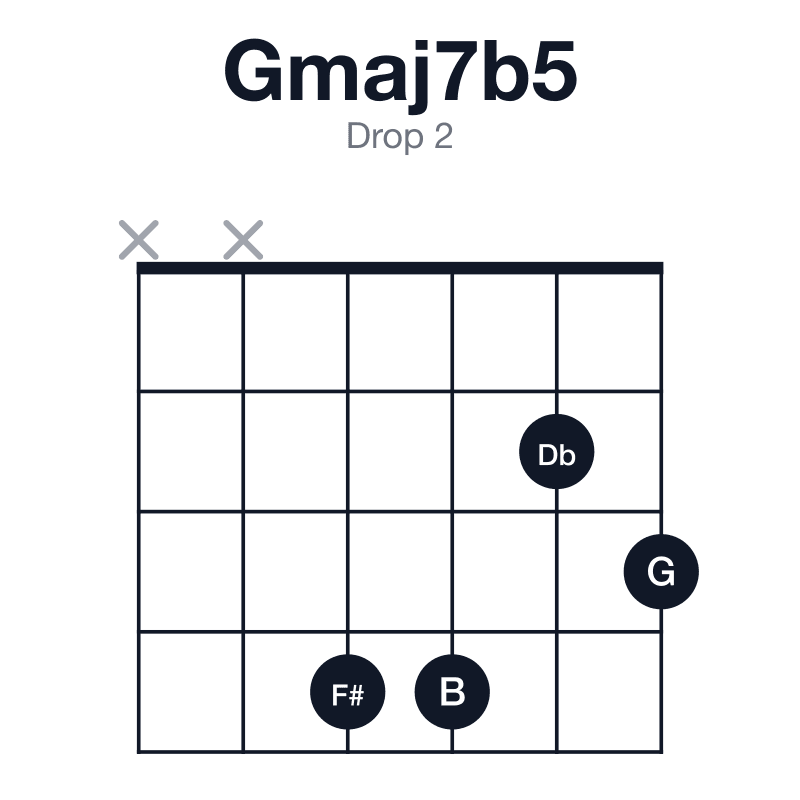
What is drop 2
Stack the four notes closely, then drop the second voice from the top an octave. It typically lands on four adjacent strings: the guitar’s workhorse voicing.
That result, 5–R–3–7, is the shape usually meant by drop 2. Named by its bass note, as the inversions are here, it is the 2nd inversion.
How to use Gmaj7b5
How you get to it. The turn that lands on Gmaj7b5 is to — the ii and the V of G — and shares its third and seventh with , so the hand barely moves between them.
Hear it land:→→
In which keys. Every note of Gmaj7b5 belongs to D major (the IV, the subdominant) and B minor (the ♭VI).
What to play over Gmaj7b5
Useful scales
- +ADE
Contains Gmaj7b5 and adds ninth, fifth and thirteenth.
- +AD#E
Contains Gmaj7b5 and adds ninth, sharp fifth and thirteenth.
Chords near Gmaj7b5
Change one note
The common shapes and the derived voicings come from different places, and both are explained in how this site is built.