Emaj13 guitar chord
- Tap a note to hear it
- Arrows change position
- Fingers, notes or intervals
- Play the chord
About Emaj13 — rootless voicings
Emaj13 is E, G#, B, D#, F# and C#. It has the same pitch name as a 6th, , above a major 7th and 9th.
Compared with , Emaj13 keeps the 6th and 9th, then adds the major 7th. That B is the difference a 6/9 chord does not have.
On guitar, root and 5th can be left out. Keep the 3rd, 7th, 9th, and 13th when the voicing needs its full identity.
Also written EM13, EΔ13 or E major 13.
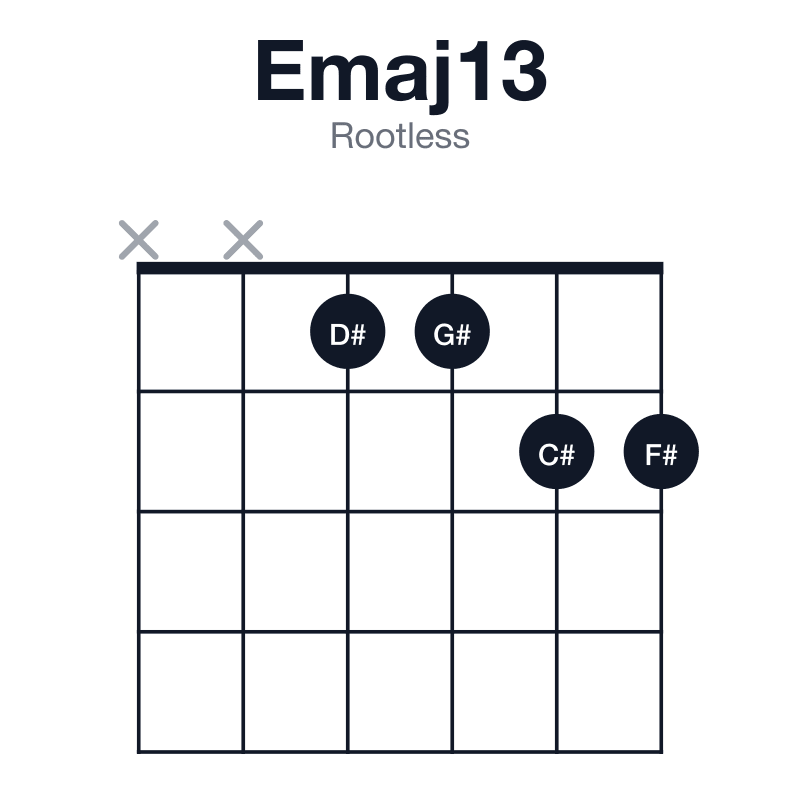
What is a rootless voicing
The bassist has the root, and the guide tones imply it anyway. The freed finger adds a tension. Playing solo, keep the root and drop something else.
How to use Emaj13
How you get to it. The turn that lands on Emaj13 is to — the ii and the V of E — and shares its third and seventh with , so the hand barely moves between them.
Hear it land:→→
In which keys. Every note of Emaj13 belongs to C# minor (the ♭III), E major (the I, the tonic), Ab minor (the ♭VI) and B major (the IV, the subdominant).
What to play over Emaj13
Useful scales
- +A
Contains Emaj13 and adds eleventh.
- +A#
Contains Emaj13 and adds sharp eleventh.
Chords near Emaj13
Change one note
The common shapes and the derived voicings come from different places, and both are explained in how this site is built.