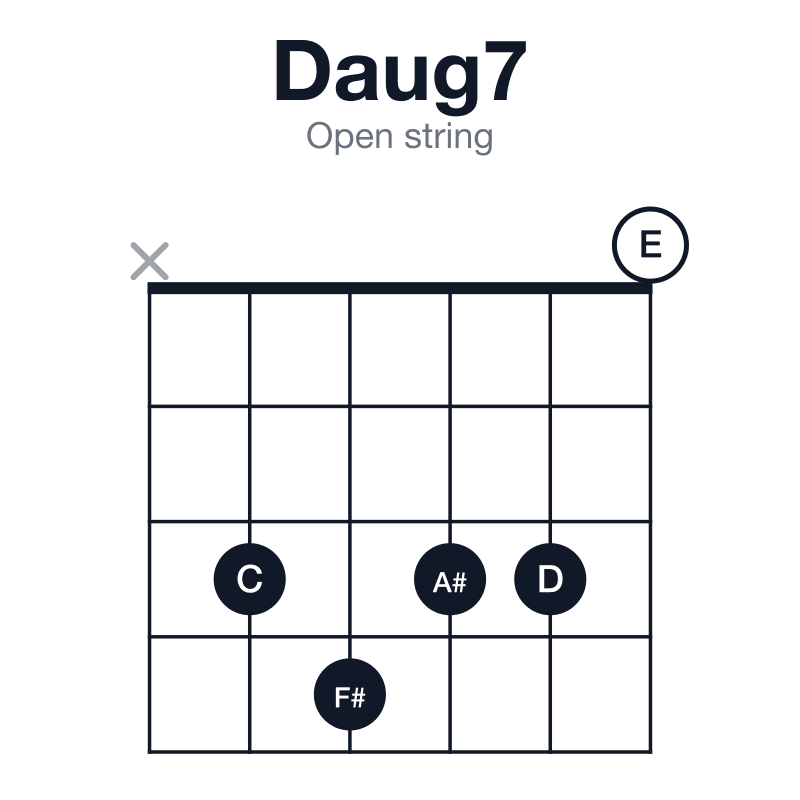
Daug7 guitar chord

Open string · ringing 9 · strings 54321 · 3rd inversion1 of 2

An open string left ringing against a fretted grip. Because it costs no finger, it sounds a note the closed shape has none left for -- a tension on top, or a pedal root underneath. Either a familiar grip with open strings added, or a shape so sparse the open strings carry the chord. These belong to their key rather than to a shape, so D, A, G and E have many and Eb a handful.

Inversion
  • Tap a note to hear it
  • Arrows change position
  • Fingers, notes or intervals
  • Play the chord
About Daug7open string voicings

Daug7 is D, F#, A# and C D7 with the fifth raised a semitone.

It sounds strained and chromatic. The raised fifth is heard as a ♭13 sitting a semitone above where it is going, so the chord pushes harder than a plain dominant.

Daug7 open string guitar chord diagram: D, F#, A#, C, played x34330
Daug7 open string, x34330 — the shape above, as a picture.

Daug7 notes and formula

Notes and interval formula
DF#A#C
13♯5♭7

Altered dominant — the pull of a 7, sharpened.

Also written D7#5, D+7 or D7(#5). The same chord either way; which spelling you meet depends on who wrote the chart.

How to play Daug7

Open-string voicing
×EADGBE

An open string left ringing against a fretted grip. It costs no finger, so it can sound a note the closed shape has none left for: a tension on top, or a pedal root underneath.

These belong to their key rather than to a shape: they cannot be moved up the neck. D, A, G and E have many; E♭ has a handful.

Daug7 has 2 of them, on strings 5-4-3-2-1 and strings 6-4-3-2-1, all of them at the 3rd fretevery inversion the chord has: A# in the bass and C in the bass. The one to learn first is the C shape at the 3rd fret, which is the easiest grip here.

Start with xx03121 open string and only 3 fretted notes. 1 of the 6 shapes here sits in open position. None of them needs a barre. Together they cover the neck from the 1st fret to the 15th.

Every common shape for Daug7
FretsWhereBassTopHand
xx0312open positionD, root positionF#1 open string
x545x64th fretD, root positionA#all fretted
x585765th fretD, root positionA#all fretted
10-9-10-x-11-x9th fretD, root positionA#all fretted
10-x-10-11-11-x10th fretD, root positionA#all fretted
x-x-12-15-13-1412th fretD, root positionF#all fretted

The same notes rebuilt from scratch give 3 shell, 14 drop 2 and 10 drop 3 voicings, each on its own page.

Tensions. A shell of Daug7, root, third and seventh, leaves a string free, and the tones that belong over it are the b9 (Eb), the 9 (E), the #9 (E#) and the #11 (G#).

How to use Daug7

Daug7 is a dominant with its tension raised, so it still points at G — harder than a plain seventh does, because the altered tones sit a semitone from where they are going.

Voice by voice, Daug7G. 3 voices move by a semitone, and one note is common to both chords.

In Daug7MovesIn G
D, the rootstays where it isD, the fifth
F#, the major thirdrises a semitoneG, the root
A#, the sharp fifthrises a semitoneB, the major third
C, the flat seventhfalls a semitoneB, the major third

What to play over Daug7

Every note of Daug7 is in D whole tone and D altered.

Chords near Daug7

Change one note of Daug7 and you have Dmaj7#5 (the flat seventh becomes a major seventh), D7 (the sharp fifth becomes a fifth), D7b5 (the sharp fifth becomes a flat fifth), Dalt (add the flat ninth), Daug (drop the flat seventh) or Daug9 (add the ninth).

Daug7 is an altered chord — a dominant seventh with its fifth or ninth moved. Altered dominant chords on every root.

On Daug7’s sound and use this page follows Mark Levine, The Jazz Theory Book (Sher Music, 1995). The shapes and the derived voicings come from different places, and both are explained in where the chords and the theory come from.

Midi Settings

7.5
Play Style
One pass of the pick from the lowest string up, everything left ringing.
Instrument
350
150

Style

Shows each chord the way this style would voice it, and marks which of its alternatives belong to the idiom.

Layout

Left Handed Mode