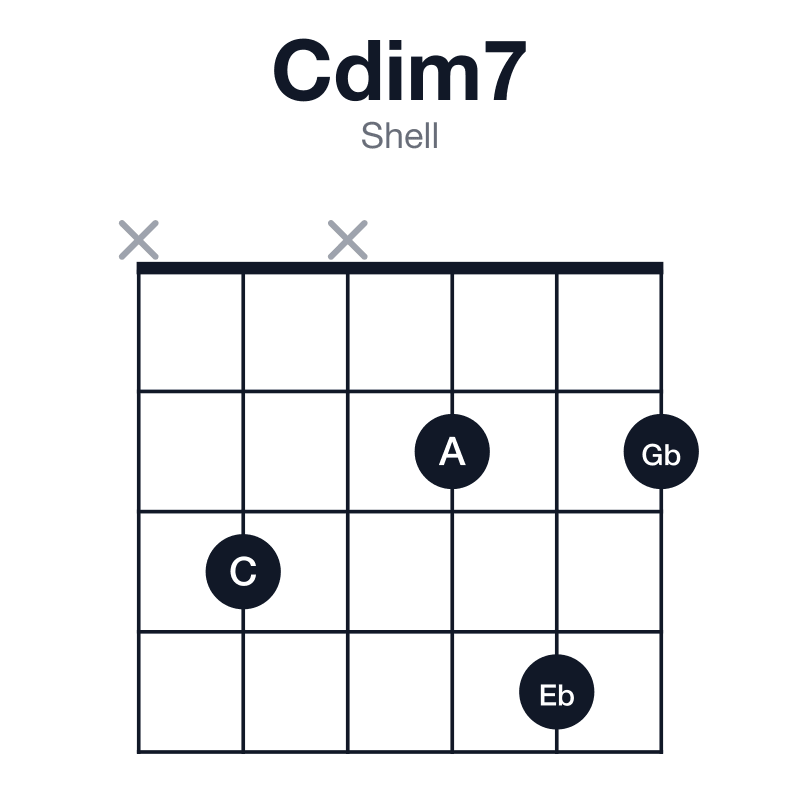
Root, third and seventh: the guide tones fix the quality, so the fifth is dropped. That is what leaves a string free, so pick a tension to put on top.
Cdim7 is C, Eb, Gb and A — Cdim with a diminished seventh stacked on top.
It sounds suspenseful and rootless. Three stacked minor thirds divide the octave evenly, so the same four notes spell four dim7 chords and the shape repeats every three frets.

| C | Eb | Gb | A |
|---|---|---|---|
| 1 | ♭3 | ♭5 | ♭♭7 |
Leading-tone or passing chord — it can resolve almost anywhere.
Also written C°7, Co7 or C diminished 7. The same chord either way; which spelling you meet depends on who wrote the chart.
Root, third and seventh. The third and seventh, the guide tones, are what make the chord major, minor or dominant, so the fifth can go: it says nothing the symbol needs.
Three notes means a spare string, which is the real point. Put a tension on it.
Cdim7 has 5 of them, on strings 5-3-2-1, strings 6-4-3-2, the middle four strings and the bottom four strings, from the 2nd fret up to the 8th — all in one inversion, so the bass note never moves. The one to learn first is the C shape at the 2nd fret.
Start with xx1212 — no barre and down at the nut. None of the shapes for Cdim7 uses an open string, so every one of them is movable; the lowest sits at the 1st fret. 2 of the 7 need a barre. Together they cover the neck from the 1st fret to the 14th.
| Frets | Where | Bass | Top | Hand |
|---|---|---|---|---|
| xx1212 | 1st fret | Eb, 1st inversion | Gb | all fretted |
| x34242 | 2nd fret | C, root position | Gb | all fretted |
| xx4545 | 4th fret | Gb, 2nd inversion | A | all fretted |
| 8x7878 | 7th fret | C, root position | C | barred |
| 8-9-10-8-10-8 | 8th fret | C, root position | C | barred |
| x-x-10-11-10-11 | 10th fret | C, root position | Eb | all fretted |
| x-x-13-14-13-14 | 13th fret | Eb, 1st inversion | Gb | all fretted |
The same notes rebuilt from scratch give 14 drop 2, 9 drop 3 and 1 open string voicings, each on its own page.
Tensions. A shell of Cdim7, root, third and seventh, leaves a string free, and the tones that belong over it are the 9 (D), the 11 (F), the b13 (Ab) and the maj7 (B).
A diminished seventh divides the octave evenly, so Cdim7 has no single root and no single destination: it can lead to F or to Db, and it is the same four notes either way.
Every note of Cdim7 is in C diminished and C half-whole diminished.
Change one note of Cdim7 and you have Cdim (drop the sixth), Cm6 (the flat fifth becomes a fifth), Cm7b5 (the sixth becomes a flat seventh) or CmMaj7b5 (the sixth becomes a major seventh).
Cdim7 is a diminished chord — root, minor third, flat fifth. Diminished and half-diminished chords on every root.
On Cdim7’s sound and use this page follows Stefan Kostka, Dorothy Payne & Byron Almén, Tonal Harmony (McGraw-Hill, 8th ed., 2018). The shapes and the derived voicings come from different places, and both are explained in where the chords and the theory come from.
Shows each chord the way this style would voice it, and marks which of its alternatives belong to the idiom.