About Abaug7 — uncommon voicings
Abaug7 is Ab, C, E and Gb — with the fifth raised a semitone.
It sounds strained and chromatic. The raised fifth is heard as a ♭13 sitting a semitone above where it is going, so the chord pushes harder than a plain dominant.
Altered dominant — the pull of a 7, sharpened.
Also written Ab7#5, Ab+7 or Ab7(#5).
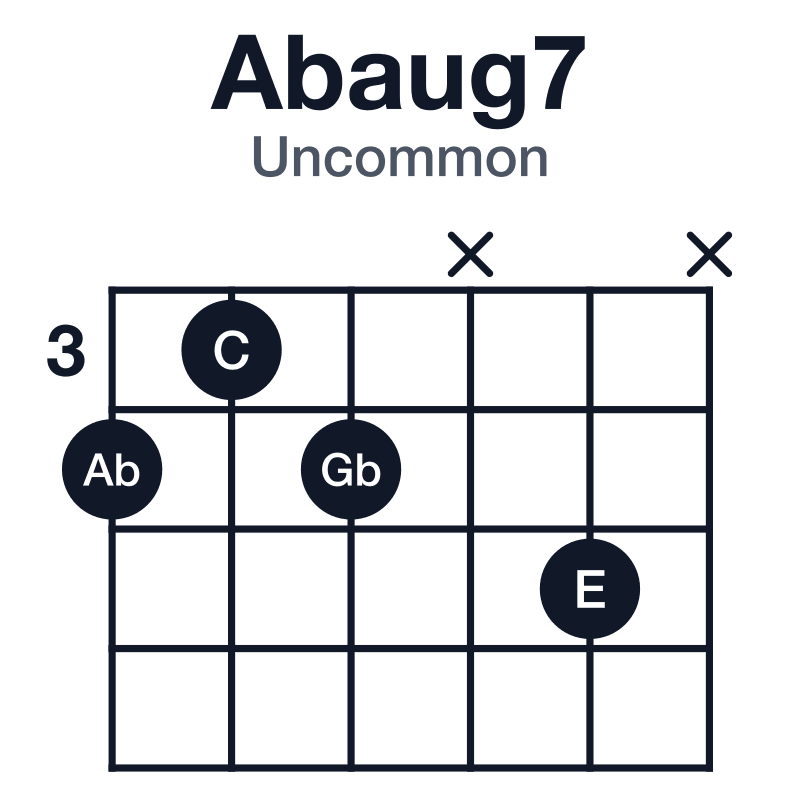
What these less common shapes are
How to use Abaug7
Abaug7 is a dominant with its tension raised, so it still points at — harder than a plain seventh does. A plain dominant has two voices a semitone from home; an altered one has four, because every altered tone is also sitting a semitone from a note of Db. More voices leaning the same way is all "more tension" means here.
What to play over Abaug7
Every note of Abaug7 is in Ab whole tone and Ab altered.
Each of those is a page: the scale across the neck, and the chords it harmonises into — which is where Abaug7 sits in it. Every scale.
Chords near Abaug7
Change one note of Abaug7 and you have (the flat seventh becomes the major seventh), (the sharp fifth becomes the fifth), (the sharp fifth becomes the flat fifth), (add the sharp ninth), (drop the flat seventh) or (add the ninth).
Abaug7 is an altered chord — a dominant seventh with its fifth or ninth moved. Altered dominant chords on every root.
The common shapes and the derived voicings come from different places, and both are explained in how this site is built.