Ab9#11 guitar chord
- Tap a note to hear it
- Arrows change position
- Fingers, notes or intervals
- Play the chord
About Ab9#11 — root position
Ab9#11 answers a naming puzzle: sounds like a flat fifth, yet the natural fifth remains present. The notes are Ab, C, Eb, Gb, Bb and D.
The symbol therefore describes an added raised fourth above , not a fifth that has been replaced. A voicing should make that distinction audible.
Also written Ab9(#11), Ab9+11 or Ab9♯11.
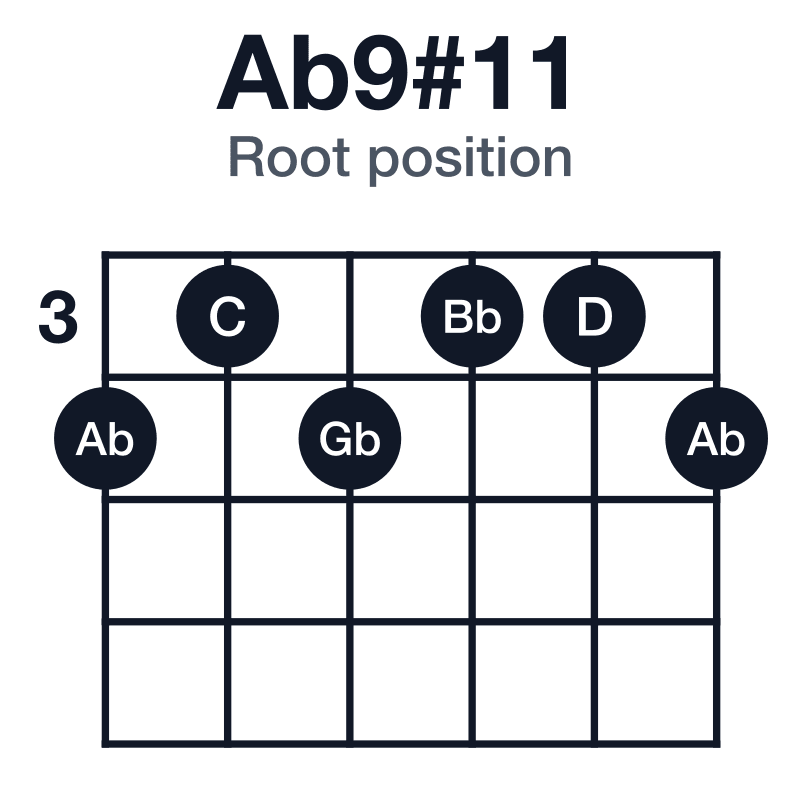
What root position means
Ab9#11 in root position puts Ab in the bass, which is the chord as it is spelled: the note it is named after underneath everything else.
5 of Ab9#11’s 6 shapes do this:4343344x453x454544xx6778x-11-12-11-13-x
How to use Ab9#11
Ab9#11 is a dominant with its tension raised, so it still points at — harder than a plain seventh does. A plain dominant has two voices a semitone from home; an altered one has four, because every altered tone is also sitting a semitone from a note of Db. More voices leaning the same way is all "more tension" means here.
What to play over Ab9#11
Useful scales
- +F
Adds thirteenth, for a dominant sharp-eleventh color.
Chords near Ab9#11
Change one note
The common shapes and the derived voicings come from different places, and both are explained in how this site is built.