Amaj7#5 guitar chord
The standard grips this chord is usually shown with.
- Tap a note to hear it
- Arrows change position
- Fingers, notes or intervals
- Play the chord
About Amaj7#5 — 2nd inversion
Amaj7#5 is A, C#, E# and G# — Amaj7 with the fifth raised a semitone.
It sounds weightless, with no pull in it. Unlike an aug7 there is no flat seventh dragging it anywhere, so it colours a tonic rather than replacing it with a dominant.
Tonic — the lydian augmented sound.
Amaj7#5 notes and formula
| A | C# | E# | G# |
|---|---|---|---|
| 1 | 3 | ♯5 | 7 |
Also written AM7#5, AΔ7#5, A+M7 or Amaj7(#5). The same chord either way; which spelling you meet depends on who wrote the chart.
How to play Amaj7#5
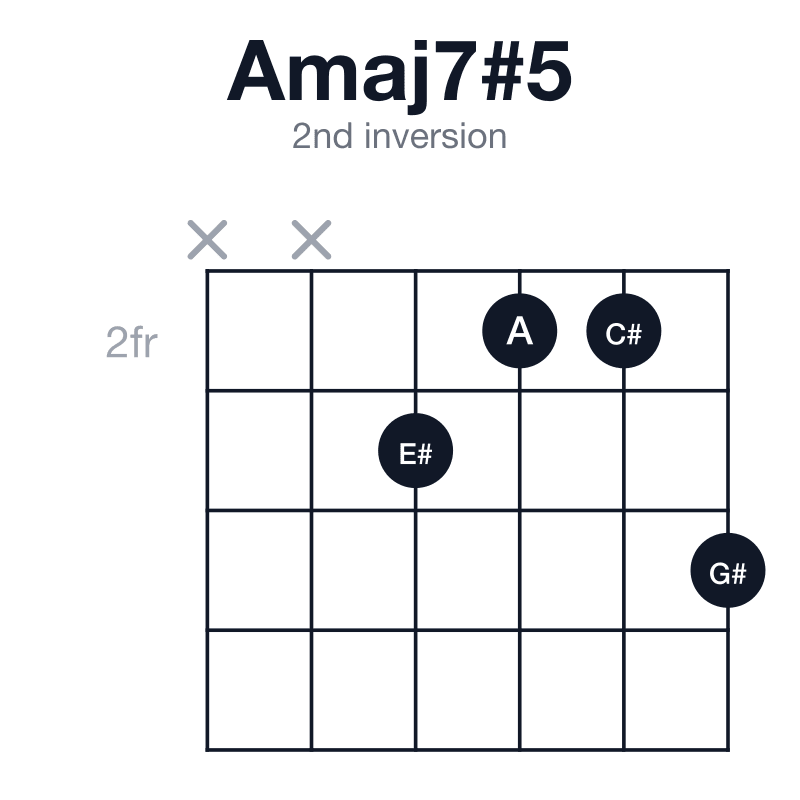
Amaj7#5 in 2nd inversion puts E# in the bass instead of A, the 5th of the chord. The notes are the same; what changes is what the bass line does, which is most of why you would reach for it — it lets the lowest voice move by step where the root would have jumped.
One of Amaj7#5’s 10 common shapes does this:xx3224
Play Amaj7#5 as a shell — root, third and seventh — and the spare string takes the 9 (B), the #11 (D#) or the 13 (F#).
All 10 common shapes as fret numbers, lowest string first. Hover or tap one to see it drawn.
- x03121, open position, A, root position, top note E#, 1 open string
- x03224, open position, A, root position, top note G#, 1 open string
- xx3224, 2nd fret, E#, 2nd inversion, top note G#, all fretted
- x06665, 5th fret, A, root position, top note A, barred
- xx7664, 4th fret, A, root position, top note G#, all fretted
- 5x6665, 5th fret, A, root position, top note A, barred
- x-x-7-10-9-9, 7th fret, A, root position, top note C#, all fretted
- x-12-11-10-9-9, 9th fret, A, root position, top note C#, all fretted
- x-12-11-13-x-13, 11th fret, A, root position, top note E#, all fretted
- x-12-15-13-14-x, 12th fret, A, root position, top note C#, all fretted
How to use Amaj7#5
How you get to it. The turn that lands on Amaj7#5 is Bm7 to E7 — the ii and the V of A — and E7 shares its third and seventh with Bm7, so the hand barely moves between them.
Chords near Amaj7#5
Change one note of Amaj7#5 and you have Amaj7 (the sharp fifth becomes the fifth), Amaj7b5 (the sharp fifth becomes the flat fifth), Aaug (drop the major seventh), Aaug7 (the major seventh becomes the flat seventh), A/F (the major seventh becomes the fifth) or A/G# (the sharp fifth becomes the fifth).
Amaj7#5 is a major chord — root, major third, fifth. Major chords on every root.
The common shapes and the derived voicings come from different places, and both are explained in how this site is built.