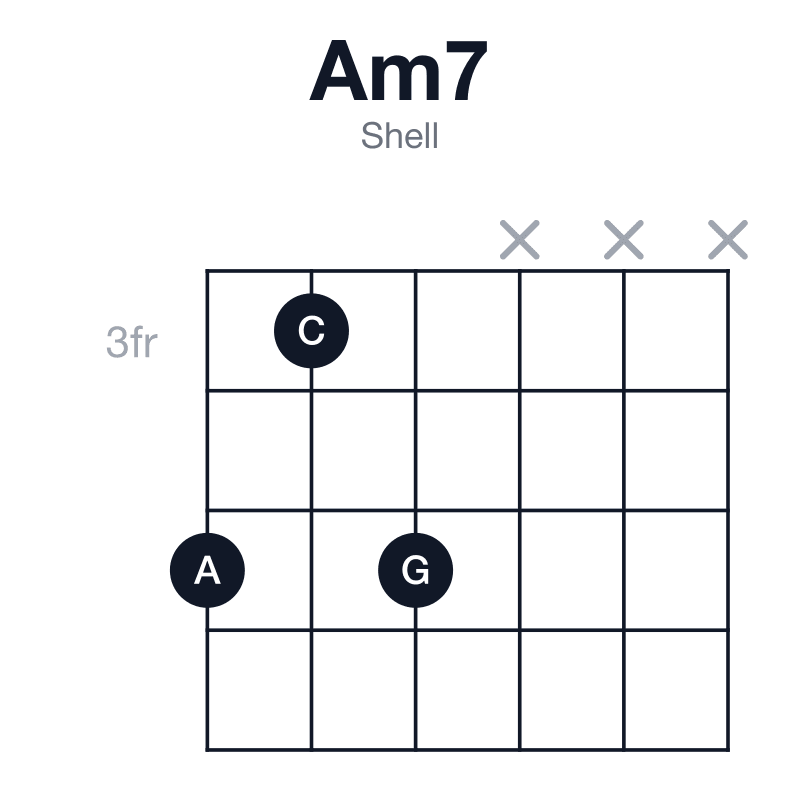
Root, third and seventh: the guide tones fix the quality, so the fifth is dropped. That is what leaves a string free, so pick a tension to put on top.
Am7 is A, C, E and G — Am with the flat seventh added.
It sounds smooth and unhurried. The ii of every major key, so most progressions you already know begin on one of these.

| A | C | E | G |
|---|---|---|---|
| 1 | ♭3 | 5 | ♭7 |
Pre-dominant — the ii of a major key, and a tonic in its own right.
Also written Amin7, A-7 or A minor 7. The same chord either way; which spelling you meet depends on who wrote the chart.
Root, third and seventh. The third and seventh, the guide tones, are what make the chord major, minor or dominant, so the fifth can go: it says nothing the symbol needs.
Three notes means a spare string, which is the real point. Put a tension on it.
Am7 has 7 of them, on the bottom three strings, the low-middle three, strings 5-3-2 and strings 6-4-3, from open position up to the 12th — all in one inversion, so the bass note never moves. The one to learn first is the A shape at the 3rd fret, which is the easiest grip here.
Start with x02010 — no barre and 3 open strings. 2 of the 9 shapes here sit in open position. 2 of the 9 need a barre. Together they cover the neck from the 1st fret to the 15th.
| Frets | Where | Bass | Top | Hand |
|---|---|---|---|---|
| x02010 | open position | A, root position | E | 3 open strings |
| x02213 | open position | A, root position | G | 1 open string |
| xx2213 | 1st fret | E, 2nd inversion | G | all fretted |
| 575555 | 5th fret | A, root position | A | barred |
| xx7988 | 7th fret | A, root position | C | all fretted |
| x-12-10-12-10-x | 10th fret | A, root position | A | all fretted |
| x-12-10-12-13-x | 10th fret | A, root position | C | all fretted |
| x-12-14-12-13-12 | 12th fret | A, root position | E | barred |
| x-x-14-14-13-15 | 13th fret | E, 2nd inversion | G | all fretted |
The same notes rebuilt from scratch give 15 drop 2, 10 drop 3 and 6 open string voicings, each on its own page.
Tensions. A shell of Am7, root, third and seventh, leaves a string free, and the tones that belong over it are the 9 (B), the 11 (D) and the 13 (F#).
How you get to it. The turn that lands on Am7 is Bm7♭5 to E7♭9: the ii and the V of A minor, which is where a minor tonic is usually arrived at rather than simply begun on.
In which keys. Every note of Am7 belongs to C major (the vi), D minor (the v), E minor (the iv), F major (the iii), G major (the ii) and A minor (the i).
Every note of Am7 is in A minor pentatonic, A blues, A dorian, A natural minor and A phrygian.
Change one note of Am7 and you have Am (drop the flat seventh), Am6 (the flat seventh becomes a sixth), Am7b5 (the fifth becomes a flat fifth), Am9 (add the ninth), AmMaj7 (the flat seventh becomes a major seventh) or Amadd9 (the flat seventh becomes a ninth).
Am7 is a minor chord — root, minor third, fifth. Minor chords on every root.
On Am7’s sound and use this page follows Mark Levine, The Jazz Theory Book (Sher Music, 1995). The shapes and the derived voicings come from different places, and both are explained in where the chords and the theory come from.
Shows each chord the way this style would voice it, and marks which of its alternatives belong to the idiom.