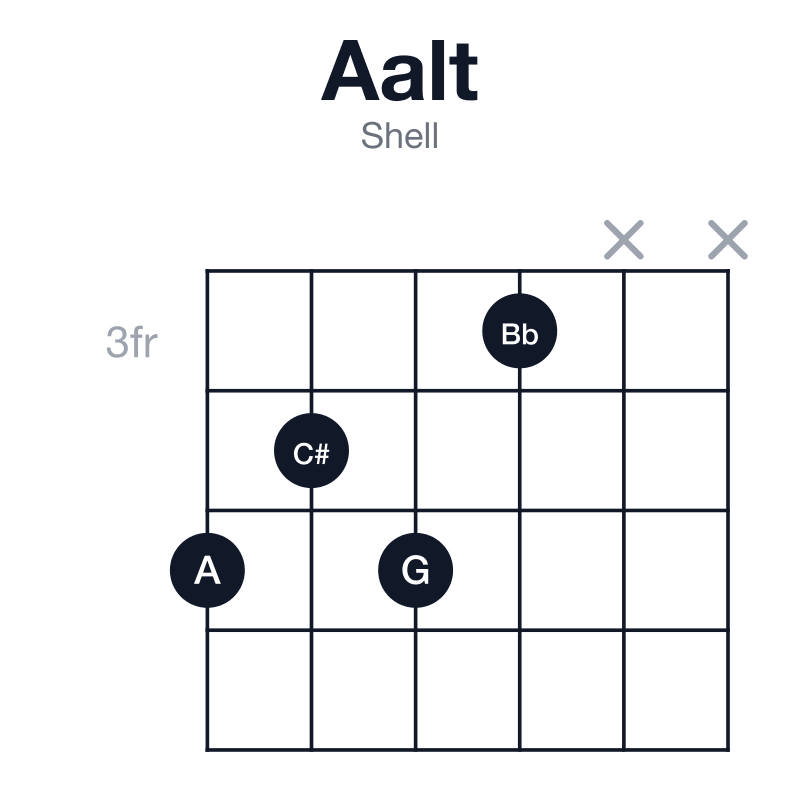
Aalt guitar chord

Shell + b9 · omits #5 · strings 6543 · Root position1 of 4

Root, third and seventh: the guide tones fix the quality, so the fifth is dropped. That is what leaves a string free, so pick a tension to put on top.

Tension
  • Tap a note to hear it
  • Arrows change position
  • Fingers, notes or intervals
  • Play the chord
About Aaltshell voicings

Aalt is A, C#, E#, G and Bb A7 with every tension it can carry altered at once.

It sounds maximum tension, barely holding together. Not one chord but an instruction: take the root, third and flat seventh, add any two alterations, and let the rest go.

Aalt shell guitar chord diagram: A, C#, E#, G, Bb, played 5453xx
Aalt shell, 5453xx — the shape above, as a picture.

Aalt notes and formula

Notes and interval formula
AC#E#GBb
13♯5♭7♭9

Altered dominant — the hardest pull available.

Also written A7alt, A7altered or A altered dominant. The same chord either way; which spelling you meet depends on who wrote the chart.

How to play Aalt

Shell voicing
R35♭7

Root, third and seventh. The third and seventh, the guide tones, are what make the chord major, minor or dominant, so the fifth can go: it says nothing the symbol needs.

Three notes means a spare string, which is the real point. Put a tension on it.

Aalt has 8 of them, on the bottom four strings, the middle four strings, the top four strings, strings 5-3-2-1 and strings 6-4-3-2, from open position up to the 12thall in one inversion, so the bass note never moves. The one to learn first is the A shape at the 3rd fret, which is the easiest grip here.

3 of them sit on strings 5-3-2-1, so you can run the inversions up one set without changing strings — which is the whole reason to learn them as a family rather than as separate grips.

Start with x0122x1 open string and only 3 fretted notes. 2 of the 10 shapes here sit in open position. None of them needs a barre. Together they cover the neck from the 1st fret to the 14th.

Every common shape for Aalt
FretsWhereBassTopHand
x0122xopen positionA, root positionC#1 open string
x07645open positionA, root positionA1 open string
54x6454th fretA, root positionAall fretted
xx76454th fretA, root positionAall fretted
5676x55th fretA, root positionAall fretted
x-x-7-8-10-97th fretA, root positionC#all fretted
x-0-11-8-10-98th fretA, root positionC#1 open string
x-12-11-x-10-1110th fretA, root positionEball fretted
x-12-11-14-14-1111th fretA, root positionEball fretted
x-12-13-14-14-x12th fretA, root positionC#all fretted

The same notes rebuilt from scratch give 15 rootless and 1 open string voicings, each on its own page.

Tensions. A shell of Aalt, root, third and seventh, leaves a string free, and the tones that belong over it are the #11 (D#).

How to use Aalt

Aalt is a dominant with its tension raised, so it still points at D — harder than a plain seventh does, because the altered tones sit a semitone from where they are going.

Voice by voice, AaltD. 4 voices move by a semitone, and one note is common to both chords.

In AaltMovesIn D
A, the rootstays where it isA, the fifth
C#, the major thirdrises a semitoneD, the root
E#, the sharp fifthrises a semitoneF#, the major third
G, the flat seventhfalls a semitoneF#, the major third
Bb, the flat ninthfalls a semitoneA, the fifth

What to play over Aalt

Every note of Aalt is in A altered.

Chords near Aalt

Change one note of Aalt and you have Aaug7 (drop the flat ninth), Aaug9 (the flat ninth becomes a ninth) or A7b9 (the sharp fifth becomes a fifth).

Aalt is an altered chord — a dominant seventh with its fifth or ninth moved. Altered dominant chords on every root.

On Aalt’s sound and use this page follows Mark Levine, The Jazz Theory Book (Sher Music, 1995). The shapes and the derived voicings come from different places, and both are explained in where the chords and the theory come from.

Midi Settings

7.5
Play Style
One pass of the pick from the lowest string up, everything left ringing.
Instrument
350
150

Style

Shows each chord the way this style would voice it, and marks which of its alternatives belong to the idiom.

Layout

Left Handed Mode