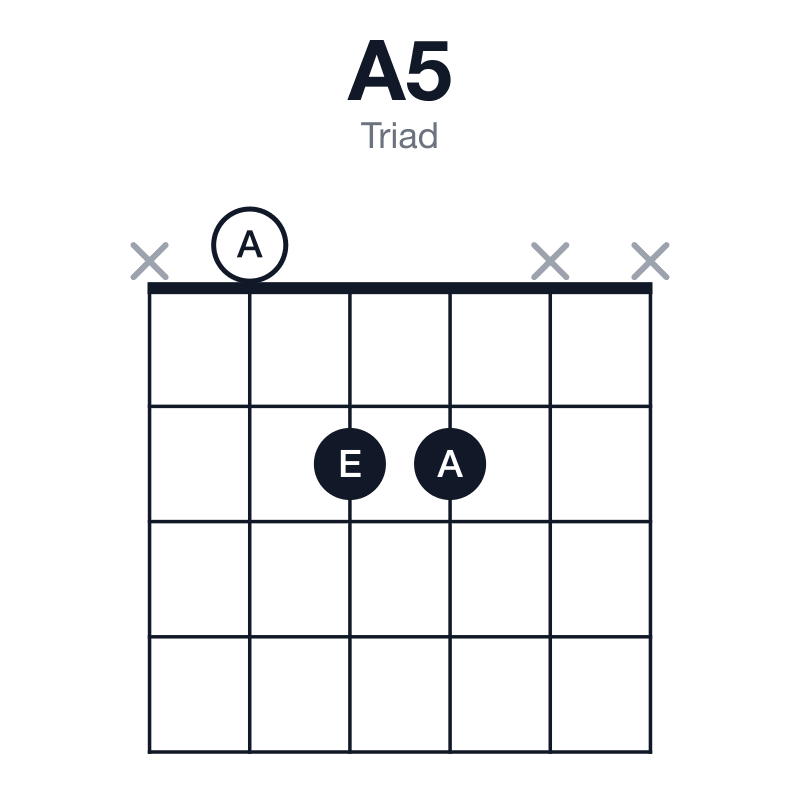
A5 is A and E — A with the third taken out altogether.
It sounds blunt, and neither major nor minor. Distortion turns a real third to mud, which is why rock guitar plays this instead of a triad.

| A | E |
|---|---|
| 1 | 5 |
Neutral — with no third it commits to no mode.
Also written A(no 3rd) or A power chord. The same chord either way; which spelling you meet depends on who wrote the chart.
Three notes on one string set. No seventh, so nothing is claimed about the chord beyond its quality.
Thin on their own, excellent over a bass line or against someone else’s harmony.
A5 has 26 of them, on the low-middle three, the bottom three strings, the bottom four strings, the top three strings, the high-middle three, strings 5-3-2-1, the middle four strings, strings 6-4-3-2 and the top four strings, from the 2nd fret up to the 9th — every inversion the chord has: A in the bass and E in the bass. The one to learn first is the A shape at the 2nd fret, which is the easiest grip here.
4 of them sit on strings 5-3-2-1, so you can run the inversions up one set without changing strings — which is the whole reason to learn them as a family rather than as separate grips.
Start with x02xxx — 1 open string and only 1 fretted note. 1 of the 3 shapes here sits in open position. None of them needs a barre. Together they cover the neck from the 2nd fret to the 14th.
| Frets | Where | Bass | Top | Hand |
|---|---|---|---|---|
| x02xxx | open position | A, root position | E | 1 open string |
| 577xxx | 5th fret | A, root position | A | all fretted |
| x-12-14-x-x-x | 12th fret | A, root position | E | all fretted |
In which keys. Every note of A5 belongs to C major (the vi), C# minor (the ♭VI), D major (the V), D minor (the v), E major (the IV), E minor (the iv), F major (the iii), F# minor (the ♭III), G major (the ii), A major (the I), A minor (the i) and B minor (the ♭VII).
Every note of A5 is in A major pentatonic, A minor pentatonic, A blues, A major and A lydian.
Change one note of A5 and you have A (add the major third), Am (add the minor third), Asus2 (add the ninth), Asus4 (add the fourth), A/E (add the major third) or A/C# (add the major third).
A5 is a suspended chord — root and fifth, with a second or fourth where the third would be — or nothing at all. Suspended and power chords on every root.
On A5’s sound and use this page follows Robert Rawlins & Nor Eddine Bahha, Jazzology (Hal Leonard, 2005). The shapes and the derived voicings come from different places, and both are explained in where the chords and the theory come from.
Shows each chord the way this style would voice it, and marks which of its alternatives belong to the idiom.