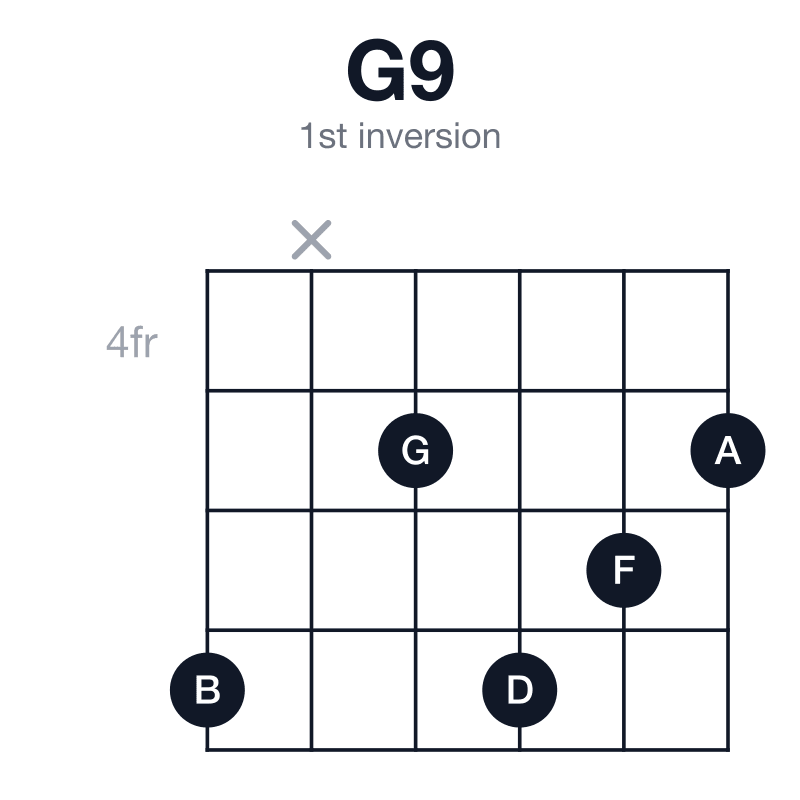
G9 guitar chord

1st inversion · B in the bass

The standard grips this chord is usually shown with.

  • Tap a note to hear it
  • Arrows change position
  • Fingers, notes or intervals
  • Play the chord

About G91st inversion

G9 is G, B, D, F and A G7 with the ninth stacked on top.

It sounds bright and full, still clearly pulling. The ninth adds height without softening the tritone underneath it, which is why funk and soul comp on this rather than on a plain 7.

Dominant — the same pull as a 7, with more colour.

G9 1st inversion guitar chord diagram: G, B, D, F, A, played 7x5765
G9 1st inversion, 7x5765 — the shape above, as a picture.

G9 notes and formula

GBDFA
135♭79

Also written Gdom9 or G dominant 9. The same chord either way; which spelling you meet depends on who wrote the chart.

How to play G9

G9 in 1st inversion puts B in the bass instead of G, the 3rd of the chord. The notes are the same; what changes is what the bass line does, which is most of why you would reach for it — it lets the lowest voice move by step where the root would have jumped.

One of G9’s 10 common shapes does this:7x5765

Play G9 as a shell — root, third and seventh — and the spare string takes the #11 (C#), the b13 (Eb) or the 13 (E).

All 10 common shapes as fret numbers, lowest string first. Hover or tap one to see it drawn.

  • 300001, open position, G, root position, top note F, 4 open strings
  • 3232xx, 2nd fret, G, root position, top note A, all fretted
  • 353235, 2nd fret, G, root position, top note A, barred
  • 353435, 3rd fret, G, root position, top note A, barred
  • xx5465, 4th fret, G, root position, top note A, all fretted
  • 7x5765, 5th fret, B, 1st inversion, top note A, all fretted
  • x-10-9-10-10-10, 9th fret, G, root position, top note D, barred
  • x-12-12-12-12-13, 12th fret, A, 9th in the bass, top note F, barred
  • 15-12-12-14-12-13, 12th fret, G, root position, top note F, barred
  • 15-14-15-14-15-x, 14th fret, G, root position, top note D, barred

How to use G9

G9 is the V of C, and that is where it goes if it goes anywhere: the third and the flat seventh are a tritone apart, and both resolve by a semitone into C.

In a phrase:Dm7G9Cmaj7the ii–V–I of C.

Voice by voice, G9C. 2 voices move by a semitone, and one note is common to both chords.

In G9MovesIn C
G, the rootstays where it isG, the fifth
B, the major thirdrises a semitoneC, the root
D, the fifthfalls a whole toneC, the root
F, the flat seventhfalls a semitoneE, the major third
A, the ninthfalls a whole toneG, the fifth

In which keys. Every note of G9 belongs to C major (the V, the dominant) and A minor (the ♭VII).

What to play over G9

Every note of G9 is in G mixolydian and G lydian dominant.

Chords near G9

Change one note of G9 and you have Gmaj9 (the flat seventh becomes the major seventh), Gm9 (the major third becomes the minor third), Gadd9 (drop the flat seventh), G69 (the flat seventh becomes the sixth), G7 (drop the ninth) or G9b5 (the fifth becomes the flat fifth).

G9 is a dominant chord — root, major third, fifth, minor seventh. Dominant seventh chords on every root.

The common shapes and the derived voicings come from different places, and both are explained in how this site is built.

Midi Settings

7.5
Play Style
One pass of the pick from the lowest string up, everything left ringing.
Instrument
350
150

Style

Shows each chord the way this style would voice it, and marks which of its alternatives belong to the idiom.

Layout

Left Handed Mode