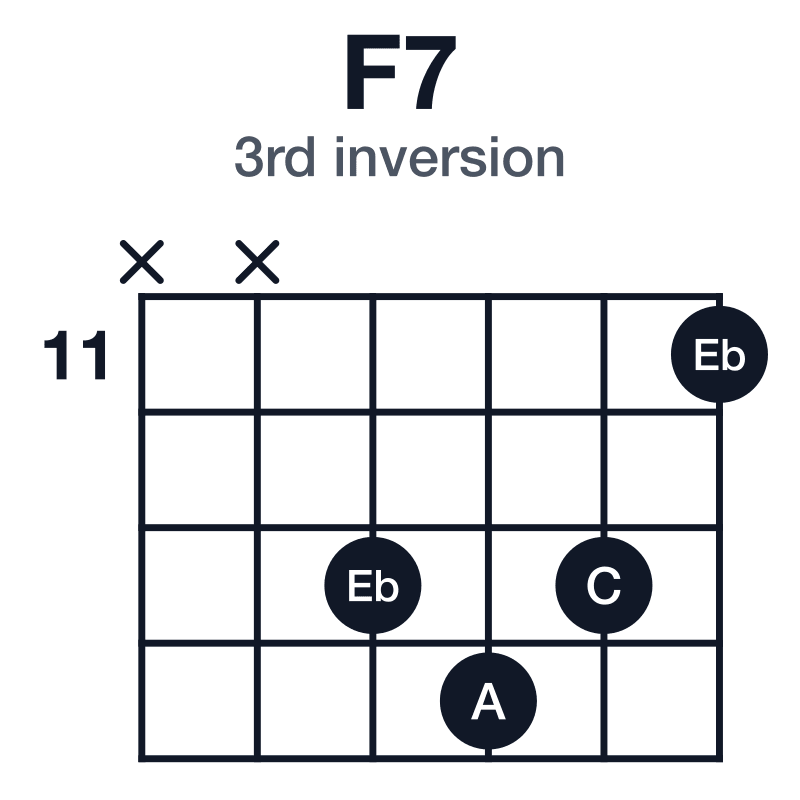
F7 guitar chord

3rd inversion · Eb in the bass
  • Tap a note to hear it
  • Arrows change position
  • Fingers, notes or intervals
  • Play the chord

About F7 — 3rd inversion

F7 takes the stable major triad and gives it somewhere to go. The new voice is ; together the notes are F, A, C and Eb.

sits a whole step below the next root. In the pair below, that single arrival changes a major chord from a resting point into a dominant.

Hear the change

One repeated root moves down a whole step to the flat seventh. The other notes stay the same.

Follow that pull to , the major chord a fourth higher. The third rises while the flat seventh falls, closing around the new root.

Also written Fdom7 or F dominant 7.

F7 3rd inversion guitar chord diagram: F, A, C, Eb, played x-x-13-14-13-11
F7 3rd inversion guitar chord voicing: x-x-13-14-13-11.

What 3rd inversion means

F7 in 3rd inversion puts Eb in the bass instead of F, the 7th of the chord. The notes are the same; what changes is what the bass line does, which is most of why you would reach for it — it lets the lowest voice move by step where the root would have jumped.

4 of F7’s 22 shapes do this:x6756xx6x56511-12-10-10-x-xx-x-13-14-13-11

How to use F7

1The pull home

V in B♭ major

F7 is the V of B♭ major. Its third and seventh are a tritone apart, the most unstable interval there is, and each resolves by a half step into the I. The dominant a tritone away shares those two notes, so it resolves the same way.

Compare with

Listen for: The dominant’s seventh falls a half step to the third of the I. Under the tritone substitute it is the same note.

2The home chord of a blues

I7 in a blues

In a blues, F7 is the home chord rather than a V: it moves to Bb7 and back without resolving. Its third and seventh each slide down a half step to become the seventh and third of Bb7, so the shape stays the same, one fret lower.

Listen for: Both notes above the bass drop one fret into the IV and come back: the third becomes the IV’s seventh.

Other uses

From the books, without a worked example
  • The VI7 of a turnaround
    VI in A♭ major

    In the turnaround in A♭ major, jazz players usually replace the vi chord with F7, and usually alter it.

    1. Abmaj7
    2. F7
    3. Bbm7
    4. Eb7
  • The Tad Dameron turnaround
    tritone substitutes in a turnaround

    Replace the VI7, II7 and V7 of a turnaround with their tritone substitutes and you get Emaj7, G7, C7, F7. F7 is the last, a half step above the I.

    1. Emaj7
    2. G7
    3. C7
    4. F7

In which keys. Every note of F7 belongs to G minor and Bb major.

What to play over F7

Useful scales

  • +GBbD

    Contains F7 and adds ninth, eleventh and thirteenth.

  • +GBD

    Adds ninth, sharp eleventh and thirteenth, for a dominant sharp-eleventh color.

  • +GbAbBD

    Contains F7 and adds flat ninth, sharp ninth, sharp eleventh and thirteenth.

Every scale

Chords near F7

Remove a note

  • 2nd inversion
    2nd inversion
    − Eb

    Remove the flat seventh.

    See F chord →

Change one note

Dominant seventh chords on every root

The common shapes and the derived voicings come from different places, and both are explained in how this site is built.