Esus2sus4 guitar chord
- Tap a note to hear it
- Arrows change position
- Fingers, notes or intervals
- Play the chord
About Esus2sus4 — drop 3 voicings
Esus2sus4 is E, F#, A and B. It leaves out the 3rd and includes both the and .
Without a or , Esus2sus4 is neither major nor minor. In jazz, sus chords can stand without resolving.
To hear what the adds, start with .
Hear the change
The 2nd drops two frets to a repeated root. The root, 4th, and 5th stay put.
Also written Esus2/4 or E suspended 2nd and 4th.
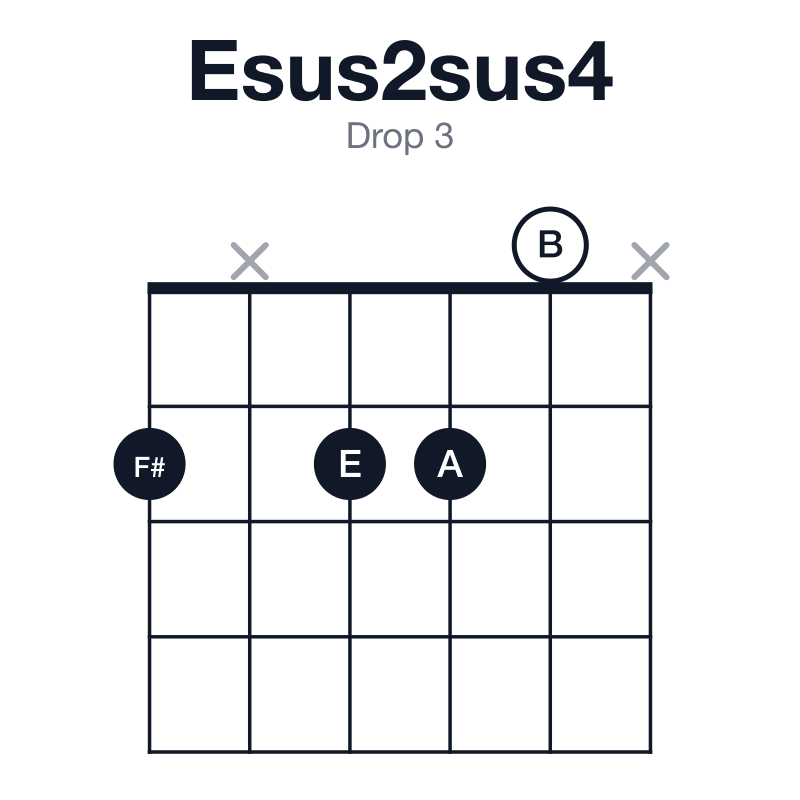
What is drop 3
Drop the third voice from the top an octave instead. The wider gap skips a string, so the muted string is part of the shape.
That result, 3–R–5–7, is the shape usually meant by drop 3. Named by its bass note, as the inversions are here, it is the 1st inversion.
More familiar jazz shapes are drop 3 than drop 2.
How to use Esus2sus4
In which keys. Every note of Esus2sus4 belongs to C# minor (the ♭III), D major (the ii), E major (the I), E minor (the i), F# minor (the ♭VII), G major (the vi), A major (the V) and B minor (the iv).
What to play over Esus2sus4
Useful scales
- +G#C#D#
Contains Esus2sus4 and adds major third, sixth and major seventh.
- +G#C#D
Adds major third, sixth and flat seventh. The flat seventh pushes the sound toward a dominant chord.
- +GCD
Contains Esus2sus4 and adds minor third, flat thirteenth and flat seventh.
- +GC#D
Contains Esus2sus4 and adds minor third, sixth and flat seventh.
- +GCD#
Contains Esus2sus4 and adds minor third, flat thirteenth and major seventh.
Chords near Esus2sus4
Change one note
open strings open strings open strings open strings
The common shapes and the derived voicings come from different places, and both are explained in how this site is built.