Esus2 guitar chord
- Tap a note to hear it
- Arrows change position
- Fingers, notes or intervals
- Play the chord
About Esus2 — triad voicings
Esus2 pauses before choosing major or minor. Its notes are E, F# and B: occupies the place where would state a third.
That open choice has two close exits. Beside , the second sits only one fret below the minor third.
Hear the change
The 2nd rises one fret to the minor 3rd. The root and fifth stay the same.
Raise the second one fret and it becomes ; raise it two and it becomes . One held shape can therefore open into either quality.
Also written E2 or E suspended 2nd.
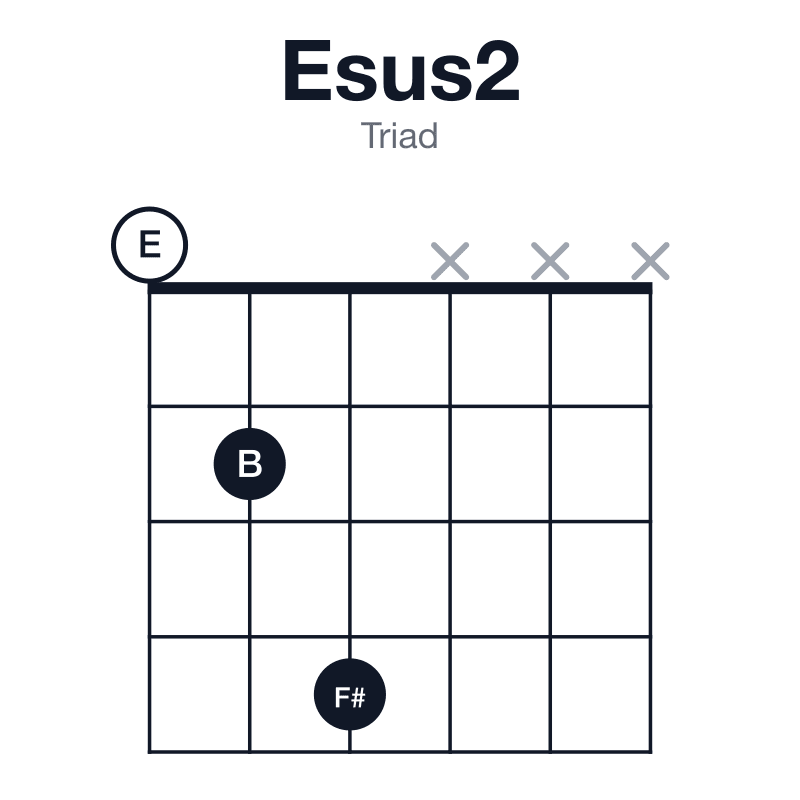
What is a triad voicing
Root, 3rd and 5th on three adjacent strings. Thin alone, great over a bass line, which decides what the chord becomes.
How to use Esus2
Voice by voice, Esus2 → . No voice moves by a semitone, and 2 notes are common to both chords. No voice has to move by a semitone, so this is a change of colour rather than a resolution.
| In Esus2 | Moves | In E |
|---|---|---|
| E, the root | stays where it is | E, the root |
| F#, the second | falls a whole tone | E, the root |
| B, the fifth | stays where it is | B, the fifth |
In which keys. Every note of Esus2 belongs to C# minor (the ♭III), D major (the ii), E major (the I), E minor (the i), F# minor (the ♭VII), G major (the vi), Ab minor (the ♭VI), A major (the V), B major (the IV) and B minor (the iv).
What to play over Esus2
Useful scales
- +G#C#
Contains Esus2 and adds major third and sixth.
- +G#AC#D#
Contains Esus2 and adds major third, fourth, sixth and major seventh.
- +G#A#C#D#
Contains Esus2 and adds major third, sharp eleventh, sixth and major seventh.
- +G#AC#D
Adds major third, fourth, sixth and flat seventh. The flat seventh pushes the sound toward a dominant chord.
- +G#A#C#D
Adds major third, sharp eleventh, sixth and flat seventh, for a dominant sharp-eleventh color.
Chords near Esus2
Remove a note
Change one note
The common shapes and the derived voicings come from different places, and both are explained in how this site is built.