About Em/F# — uncommon voicings
Em/F# is F#, E, G and B — with F♯ put in the bass.
It sounds like the minor triad it is, resting on a different floor. If F♯ is already one of the chord’s notes this is an inversion, and if it is not it is a new colour under an unchanged chord; either way the reason to reach for it is a bass line that walks by step where root-position chords would leap.
Inversion or pedal — the harmony is unchanged; only the bass moves.
Also written Em over F# or Em with F# in the bass.
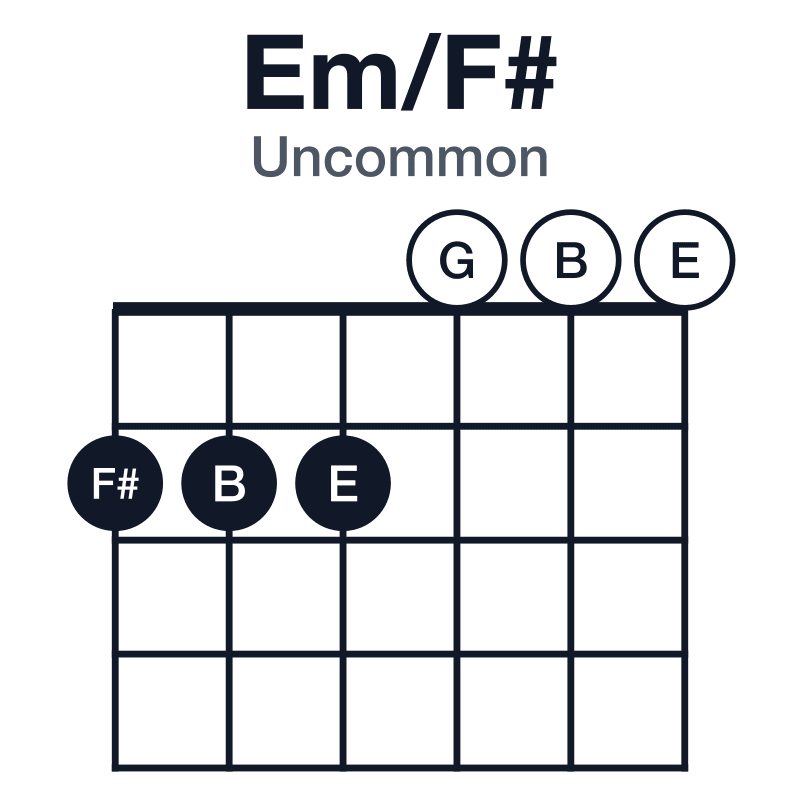
What these less common shapes are
How to use Em/F#
In which keys. Every note of Em/F# belongs to D major (the ii, the supertonic), E minor (the i, the tonic), G major (the vi, the submediant) and B minor (the iv, the subdominant).
What to play over Em/F#
Every note of Em/F# is in E natural minor, E dorian, E harmonic minor and E melodic minor.
Each of those is a page: the scale across the neck, and the chords it harmonises into — which is where Em/F# sits in it. Every scale.
Chords near Em/F#
Change one note of Em/F# and you have (drop the second), (drop the minor third), (the minor third becomes the fourth), (the second becomes the sixth), (add the sixth) or (the second becomes the flat seventh).
Em/F# is a slash chord — a triad over a named bass note. Slash chords on every root.
The common shapes and the derived voicings come from different places, and both are explained in how this site is built.