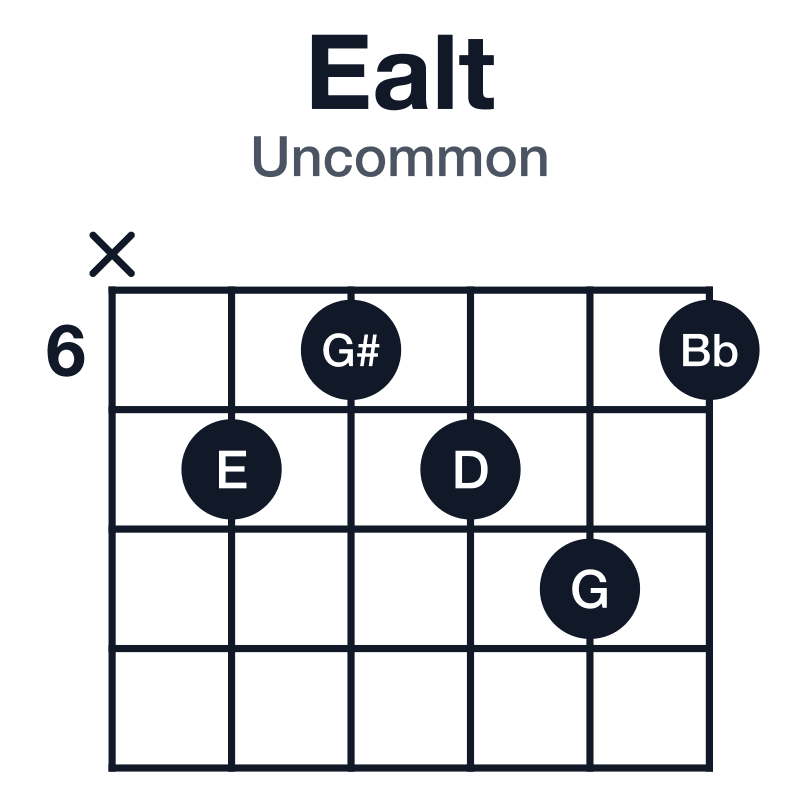
Ealt guitar chord

1 of 4
  • Tap a note to hear it
  • Arrows change position
  • Fingers, notes or intervals
  • Play the chord

About Ealtuncommon voicings

Ealt is E, G#, D, G and C with every tension it can carry altered at once.

It sounds maximum tension, barely holding together. Not one chord but an instruction: take the root, third and flat seventh, add any two alterations, and let the rest go.

Altered dominant — the hardest pull available.

Also written E7alt, E7altered or E altered dominant.

Ealt uncommon guitar chord diagram: E, G#, D, G, C, played x76786
Ealt uncommon, x76786 — the shape above, as a picture.

What these less common shapes are

How to use Ealt

1The V of a minor ii–V–i

V in A minor

Alt is not one chord but an instruction: a dominant with its ninth and fifth altered. Its usual home is between Bm7b5 and Am6, where the ♭13 is already the minor third of the chord it resolves to.

Listen for: The ii’s minor third falls a whole step to the V’s ♭13, which holds as the minor third of the i.

2A secondary dominant in major

I – VI7alt – ii – V

In a major key Ealt works as the V of the ii: Gmaj7, Ealt, Am7, D7. Its ♭13 is the minor third of the ii it leads to.

Listen for: The top voice rises a half step to the ♭13 and then stays put: minor third of the ii, flat seventh of the V.

What to play over Ealt

Every note of Ealt is in E altered.

Each of those is a page: the scale across the neck, and the chords it harmonises into — which is where Ealt sits in it. Every scale.

Chords near Ealt

Change one note of Ealt and you have (drop the sharp ninth), (the sharp ninth becomes the ninth) or (the flat thirteenth becomes the fifth).

Ealt is an altered chord — a dominant seventh with its fifth or ninth moved. Altered dominant chords on every root.

The common shapes and the derived voicings come from different places, and both are explained in how this site is built.

Midi Settings

7.5
Play Style
One pass of the pick from the lowest string up, everything left ringing.
Instrument
350
150

Style

Shows each chord the way this style would voice it, and marks which of its alternatives belong to the idiom.

Layout

Left Handed Mode