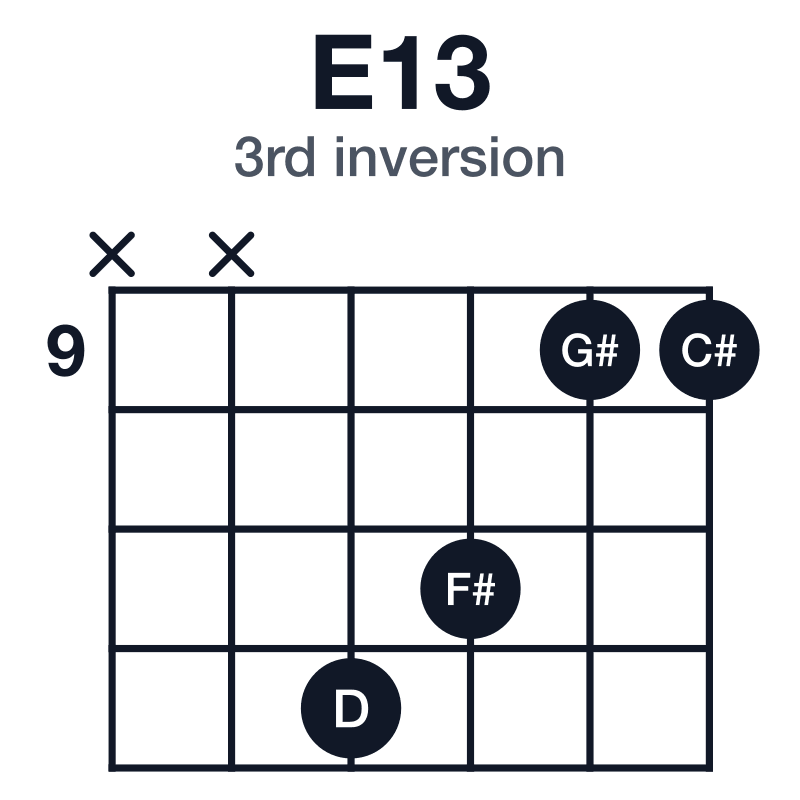
E13 guitar chord

3rd inversion · D in the bass
1 of 3
  • Tap a note to hear it
  • Arrows change position
  • Fingers, notes or intervals
  • Play the chord

About E13 — 3rd inversion

E13 is a dominant stretched across six different notes: E, G#, B, D, F# and C#. Its distant voices are and .

On guitar, keep the third and flat seventh, then make room by dropping the root or fifth. The upper voices can carry a jazz cadence around that shell.

Also written Edom13 or E dominant 13.

E13 3rd inversion guitar chord diagram: E, G#, B, D, F#, C#, played x-x-12-11-9-9
E13 3rd inversion guitar chord voicing: x-x-12-11-9-9.

What 3rd inversion means

E13 in 3rd inversion puts D in the bass instead of E, the 7th of the chord. The notes are the same; what changes is what the bass line does, which is most of why you would reach for it — it lets the lowest voice move by step where the root would have jumped.

5 of E13’s 14 shapes do this:x5665xx5669xx-x-12-11-9-9x-x-12-13-14-12x-x-12-13-14-14

How to use E13

1The V of an extended ii–V–I

V in A major

In a jazz ii–V–I all three chords usually carry tensions: Bm9, E13, Amaj9 rather than bare sevenths. The thirteenth is the ii’s ninth held over the barline, and it falls a step to the ninth of the I.

Listen for: The ii’s ninth holds as the V’s thirteenth, then falls a whole step to the ninth of the I. Underneath, the guide tones step down as usual.

In which keys. Every note of E13 belongs to F# minor and A major.

What to play over E13

Useful scales

Every scale

Chords near E13

Remove a note

Change one note

Dominant seventh chords on every root

The common shapes and the derived voicings come from different places, and both are explained in how this site is built.

Midi Settings

7.5
Play Style
One pass of the pick from the lowest string up, everything left ringing.
Instrument
350
150

Style

Shows each chord the way this style would voice it, and marks which of its alternatives belong to the idiom.

Layout

Left Handed Mode