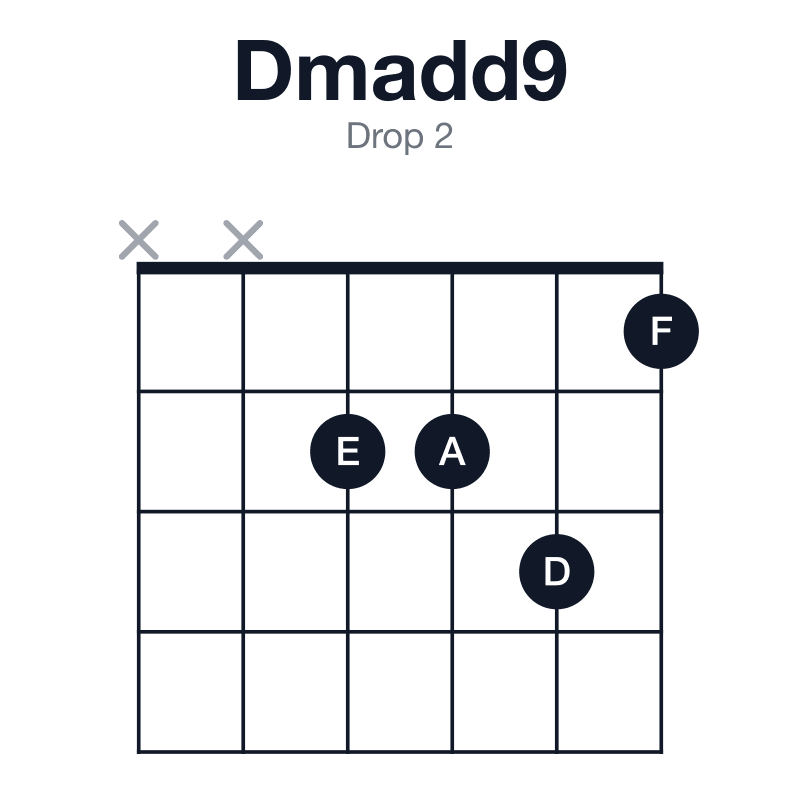
Dmadd9 guitar chord

Drop 2 · strings 4321 · 9th in bass1 of 13

A close-position chord with the second voice from the top lowered an octave. Sits on four adjacent strings.

Inversion
  • Tap a note to hear it
  • Arrows change position
  • Fingers, notes or intervals
  • Play the chord
About Dmadd9drop 2 voicings

Dmadd9 is D, F, A and E Dm with the ninth added, and no seventh.

It sounds sharp-edged. The ninth grinding a whole step under the minor third is the edge an m9 softens.

Dmadd9 drop 2 guitar chord diagram: D, F, A, E, played xx2231
Dmadd9 drop 2, xx2231 — the shape above, as a picture.

Dmadd9 notes and formula

Notes and interval formula
DFAE
1♭359

Minor tonic — a triad with one colour on it.

Also written Dm(add9), Dmin(add9) or D-add9. The same chord either way; which spelling you meet depends on who wrote the chart.

How to play Dmadd9

Drop 2
close
753R
dropped
73R5

Take the four notes stacked as close together as they go, then drop the second voice from the top an octave. The gap it opens is what makes the chord sound like a chord rather than a cluster.

It lands on four adjacent strings, which is why it is the workhorse voicing on guitar.

×EADGB

Dmadd9 has 13 of them, on the top four strings, the middle four strings and the bottom four strings, from open position up to the 13thevery inversion the chord has: D in the bass, F in the bass, A in the bass and E in the bass. The one to learn first is the E shape at the nut, which is the easiest grip here.

5 of them sit on the top four strings, so you can run the inversions up one set without changing strings — which is the whole reason to learn them as a family rather than as separate grips.

Start with x53230no barre and 1 open string. 1 of the 9 shapes here sits in open position. 2 of the 9 need a barre. Together they cover the neck from the 2nd fret to the 15th.

Every common shape for Dmadd9
FretsWhereBassTopHand
x53230open positionD, root positionE1 open string
x5325x2nd fretD, root positionEall fretted
x53x553rd fretD, root positionAbarred
x577605th fretD, root positionF1 open string
x8775x5th fretF, 1st inversionEall fretted
10-8-x-9-10-x8th fretD, root positionAall fretted
10-12-12-10-10-1210th fretD, root positionEbarred
x-x-12-10-10-1210th fretD, root positionEall fretted
x-x-15-14-15-1212th fretF, 1st inversionEall fretted

The same notes rebuilt from scratch give 9 drop 3 and 4 open string voicings, each on its own page.

How to use Dmadd9

How you get to it. The turn that lands on Dmadd9 is Em7♭5 to A7♭9: the ii and the V of D minor, which is where a minor tonic is usually arrived at rather than simply begun on.

In which keys. Every note of Dmadd9 belongs to C major (the ii, the supertonic), D minor (the i, the tonic), F major (the vi, the submediant) and A minor (the iv, the subdominant).

What to play over Dmadd9

Every note of Dmadd9 is in D dorian, D natural minor, D harmonic minor and D melodic minor.

Chords near Dmadd9

Change one note of Dmadd9 and you have Dm (drop the ninth), Dsus2 (drop the minor third), Dsus2sus4 (the minor third becomes a fourth), Dm6 (the ninth becomes a sixth), Dm69 (add the sixth) or Dm7 (the ninth becomes a flat seventh).

Dmadd9 is a minor chord — root, minor third, fifth. Minor chords on every root.

On Dmadd9’s sound and use this page follows Robert Rawlins & Nor Eddine Bahha, Jazzology (Hal Leonard, 2005). The shapes and the derived voicings come from different places, and both are explained in where the chords and the theory come from.

Midi Settings

7.5
Play Style
One pass of the pick from the lowest string up, everything left ringing.
Instrument
350
150

Style

Shows each chord the way this style would voice it, and marks which of its alternatives belong to the idiom.

Layout

Left Handed Mode