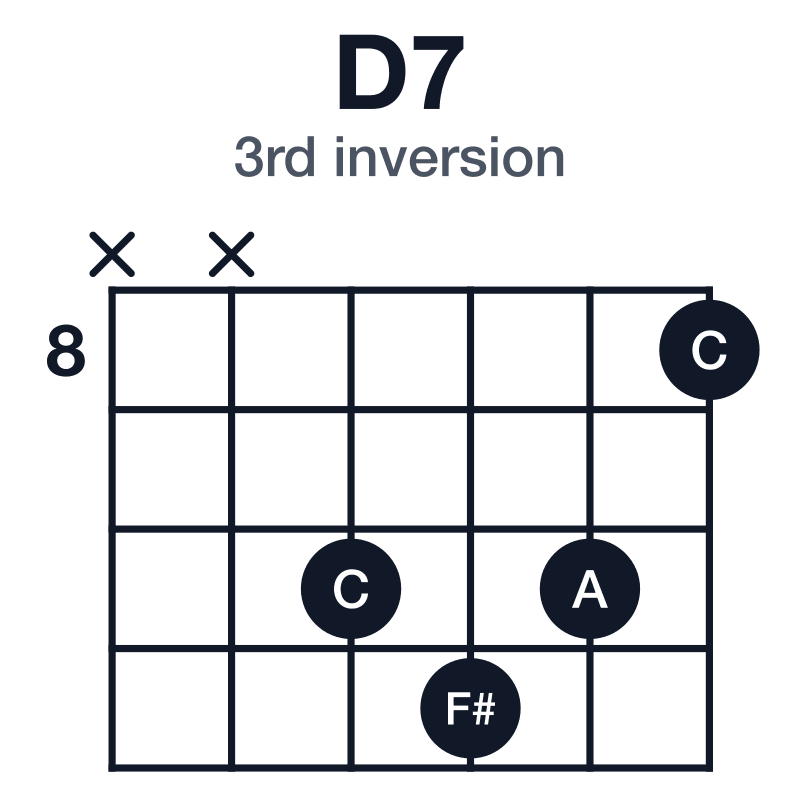
D7 guitar chord

3rd inversion · C in the bass
  • Tap a note to hear it
  • Arrows change position
  • Fingers, notes or intervals
  • Play the chord

About D7 — 3rd inversion

D7 takes the stable major triad and gives it somewhere to go. The new voice is ; together the notes are D, F#, A and C.

sits a whole step below the next root. In the pair below, that single arrival changes a major chord from a resting point into a dominant.

Hear the change

One repeated root moves down a whole step to the flat seventh. The other notes stay the same.

Follow that pull to , the major chord a fourth higher. The third rises while the flat seventh falls, closing around the new root.

Also written Ddom7 or D dominant 7.

D7 3rd inversion guitar chord diagram: D, F#, A, C, played x-x-10-11-10-8
D7 3rd inversion guitar chord voicing: x-x-10-11-10-8.

What 3rd inversion means

D7 in 3rd inversion puts C in the bass instead of D, the 7th of the chord. The notes are the same; what changes is what the bass line does, which is most of why you would reach for it — it lets the lowest voice move by step where the root would have jumped.

4 of D7’s 21 shapes do this:x3423xx3x2328977xxx-x-10-11-10-8

How to use D7

1The pull home

V in G major

D7 is the V of G major. Its third and seventh are a tritone apart, the most unstable interval there is, and each resolves by a half step into the I. The dominant a tritone away shares those two notes, so it resolves the same way.

Compare with

Listen for: The dominant’s seventh falls a half step to the third of the I. Under the tritone substitute it is the same note.

2The home chord of a blues

I7 in a blues

In a blues, D7 is the home chord rather than a V: it moves to G7 and back without resolving. Its third and seventh each slide down a half step to become the seventh and third of G7, so the shape stays the same, one fret lower.

Listen for: Both notes above the bass drop one fret into the IV and come back: the third becomes the IV’s seventh.

Other uses

From the books, without a worked example
  • The VI7 of a turnaround
    VI in F major

    In the turnaround in F major, jazz players usually replace the vi chord with D7, and usually alter it.

    1. Fmaj7
    2. D7
    3. Gm7
    4. C7
  • The Tad Dameron turnaround
    tritone substitutes in a turnaround

    Replace the VI7, II7 and V7 of a turnaround with their tritone substitutes and you get C#maj7, E7, A7, D7. D7 is the last, a half step above the I.

    1. C#maj7
    2. E7
    3. A7
    4. D7

In which keys. Every note of D7 belongs to E minor and G major.

What to play over D7

Useful scales

Every scale

Chords near D7

Remove a note

  • 2nd inversion
    2nd inversion
    − C

    Remove the flat seventh.

    See D chord →

Change one note

  • open strings
    open strings
    C → C#

    Raise the flat seventh to the major seventh.

    See Dmaj7 chord →
  • open strings
    open strings
    F# → F

    Lower the major third to the minor third.

    See Dm7 chord →
  • C → E

    Replace the flat seventh with the ninth.

    See Dadd9 chord →
  • open strings
    open strings
    C → B

    Lower the flat seventh to the sixth.

    See D6 chord →
  • open strings
    open strings
    F# → G

    Raise the major third to the fourth.

    See D7sus4 chord →
  • open strings
    open strings
    A → Ab

    Lower the fifth to the flat fifth.

    See D7b5 chord →
  • open strings
    open strings
    A → A#

    Raise the fifth to the sharp fifth.

    See Daug7 chord →

Dominant seventh chords on every root

The common shapes and the derived voicings come from different places, and both are explained in how this site is built.

Midi Settings

7.5
Play Style
One pass of the pick from the lowest string up, everything left ringing.
Instrument
350
150

Style

Shows each chord the way this style would voice it, and marks which of its alternatives belong to the idiom.

Layout

Left Handed Mode