Csus2sus4 guitar chord
An open string left ringing against a fretted grip. Because it costs no finger, it sounds a note the closed shape has none left for -- a tension on top, or a pedal root underneath. Either a familiar grip with open strings added, or a shape so sparse the open strings carry the chord. These belong to their key rather than to a shape, so D, A, G and E have many and Eb a handful.
- Tap a note to hear it
- Arrows change position
- Fingers, notes or intervals
- Play the chord
About Csus2sus4 — open string voicings
Csus2sus4 is C, D, F and G — Csus4 with the second added underneath the fourth.
It sounds ringing and deliberately ambiguous. Read another way it is a stack of fourths, which is why it works as a pad rather than as a chord that resolves.
Csus2sus4 notes and formula
| C | D | F | G |
|---|---|---|---|
| 1 | 2 | 4 | 5 |
Texture more than function — still no third.
Also written Csus2/4 or C suspended 2nd and 4th. The same chord either way; which spelling you meet depends on who wrote the chart.
How to play Csus2sus4
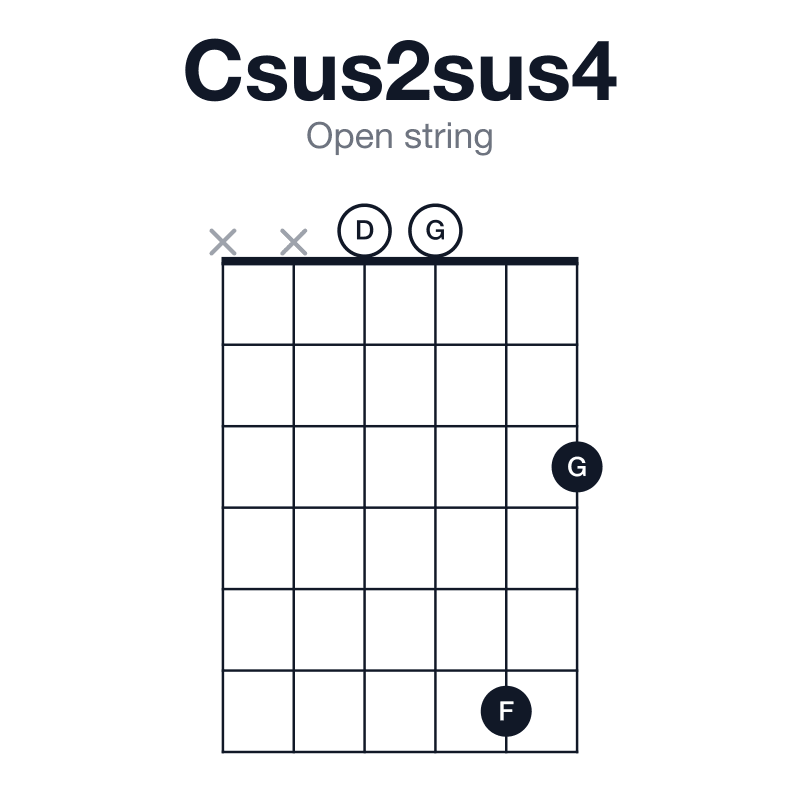
An open string left ringing against a fretted grip. It costs no finger, so it can sound a note the closed shape has none left for: a tension on top, or a pedal root underneath.
These belong to their key rather than to a shape: they cannot be moved up the neck. D, A, G and E have many; E♭ has a handful.
Csus2sus4 has 2 of them, on the top four strings and strings 6-4-3-2, all of them at the 3rd fret — every inversion the chord has: D in the bass and G in the bass. The one to learn first is the D shape at the 3rd fret.
Start with x30011 — no barre and 2 open strings. 2 of the 6 shapes here sit in open position. 3 of the 6 need a barre. Together they cover the neck from the 1st fret to the 15th.
| Frets | Where | Bass | Top | Hand |
|---|---|---|---|---|
| x33033 | open position | C, root position | G | barred |
| x30011 | open position | C, root position | F | 2 open strings |
| x33533 | 3rd fret | C, root position | G | barred |
| 8857xx | 5th fret | C, root position | D | all fretted |
| 8-8-10-10-8-10 | 8th fret | C, root position | D | barred |
| x-15-12-12-13-13 | 12th fret | C, root position | F | all fretted |
The same notes rebuilt from scratch give 15 drop 2 and 10 drop 3 voicings, each on its own page.
How to use Csus2sus4
In which keys. Every note of Csus2sus4 belongs to C major (the I), C minor (the i), D minor (the ♭VII), Eb major (the vi), F major (the V), G minor (the iv), A minor (the ♭III) and Bb major (the ii).
What to play over Csus2sus4
Every note of Csus2sus4 is in C major, C mixolydian, C dorian, C natural minor and C harmonic minor.
Chords near Csus2sus4
Change one note of Csus2sus4 and you have Csus2 (drop the fourth), Csus4 (drop the ninth), Cadd9 (the fourth becomes a major third), Cmadd9 (the fourth becomes a minor third), C7sus4 (the ninth becomes a flat seventh) or C11 (add the flat seventh).
Csus2sus4 is a suspended chord — root and fifth, with a second or fourth where the third would be — or nothing at all. Suspended and power chords on every root.
On Csus2sus4’s sound and use this page follows Robert Rawlins & Nor Eddine Bahha, Jazzology (Hal Leonard, 2005). The shapes and the derived voicings come from different places, and both are explained in where the chords and the theory come from.