Bmadd9 guitar chord
The standard grips this chord is usually shown with.
- Tap a note to hear it
- Arrows change position
- Fingers, notes or intervals
- Play the chord
About Bmadd9 — 1st inversion
Bmadd9 is B, D, F# and C# — Bm with the ninth added, and no seventh.
It sounds sharp-edged. The ninth grinding a whole step under the minor third is the edge an m9 softens.
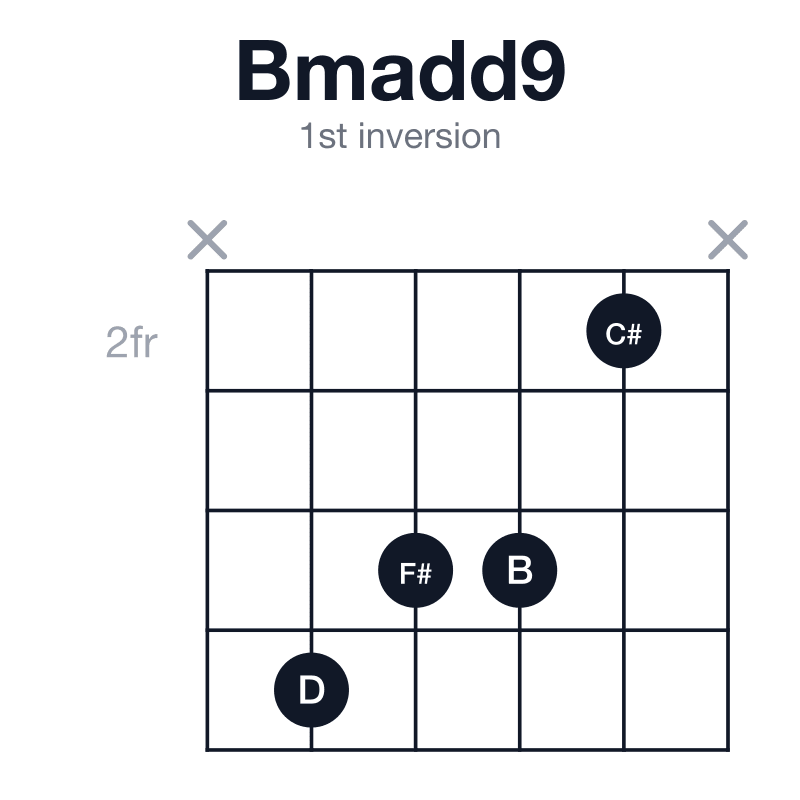
Bmadd9 notes and formula
| B | D | F# | C# |
|---|---|---|---|
| 1 | ♭3 | 5 | 9 |
Minor tonic — a triad with one colour on it.
Also written Bm(add9), Bmin(add9) or B-add9. The same chord either way; which spelling you meet depends on who wrote the chart.
How to play Bmadd9
Bmadd9 in 1st inversion puts D in the bass instead of B, the 3rd of the chord. The notes are the same; what changes is what the bass line does, which is most of why you would reach for it — it lets the lowest voice move by step where the root would have jumped.
2 of Bmadd9’s 7 common shapes do this: x5442x, x-x-12-11-12-9.
Start with x5442x — no barre and down at the nut. None of the shapes for Bmadd9 uses an open string, so every one of them is movable; the lowest sits at the 2nd fret. 2 of the 7 need a barre. Together they cover the neck from the 2nd fret to the 14th.
| Frets | Where | Bass | Top | Hand |
|---|---|---|---|---|
| x5442x | 2nd fret | D, 1st inversion | C# | all fretted |
| 75067x | 5th fret | B, root position | F# | 1 open string |
| 799779 | 7th fret | B, root position | C# | barred |
| xx9779 | 7th fret | B, root position | C# | all fretted |
| x-x-12-11-12-9 | 9th fret | D, 1st inversion | C# | all fretted |
| x-14-12-11-14-x | 11th fret | B, root position | C# | all fretted |
| x-14-12-x-14-14 | 12th fret | B, root position | F# | barred |
The same notes rebuilt from scratch give 12 drop 2, 8 drop 3 and 2 open string voicings, each on its own page.
How to use Bmadd9
How you get to it. The turn that lands on Bmadd9 is C#m7♭5 to F#7♭9: the ii and the V of B minor, which is where a minor tonic is usually arrived at rather than simply begun on.
In which keys. Every note of Bmadd9 belongs to D major (the vi, the submediant), F# minor (the iv, the subdominant), A major (the ii, the supertonic) and B minor (the i, the tonic).
What to play over Bmadd9
Every note of Bmadd9 is in B dorian, B natural minor, B harmonic minor and B melodic minor.
Chords near Bmadd9
Change one note of Bmadd9 and you have Bm (drop the ninth), Bsus2 (drop the minor third), Bsus2sus4 (the minor third becomes a fourth), Bm6 (the ninth becomes a sixth), Bm69 (add the sixth) or Bm7 (the ninth becomes a flat seventh).
Bmadd9 is a minor chord — root, minor third, fifth. Minor chords on every root.
On Bmadd9’s sound and use this page follows Robert Rawlins & Nor Eddine Bahha, Jazzology (Hal Leonard, 2005). The shapes and the derived voicings come from different places, and both are explained in where the chords and the theory come from.