Gsus2 guitar chord
- Tap a note to hear it
- Arrows change position
- Fingers, notes or intervals
- Play the chord
About Gsus2 — inversions voicings
Gsus2 is G, A and D — with the third replaced by the second.
It sounds open, and neither major nor minor. With no third it works over either quality, which is why strummed parts lean on it.
Suspended — it hangs until something moves.
Also written G2 or G suspended 2nd.
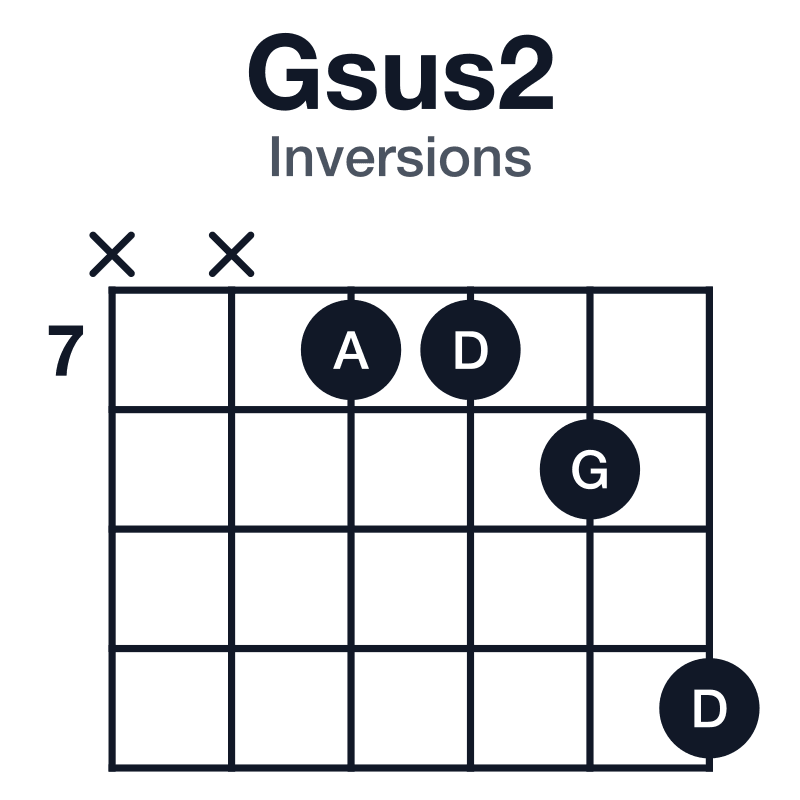
What an inversion is
How to use Gsus2
Voice by voice, Gsus2 → . No voice moves by a semitone, and 2 notes are common to both chords. No voice has to move by a semitone, so this is a change of colour rather than a resolution.
| In Gsus2 | Moves | In G |
|---|---|---|
| G, the root | stays where it is | G, the root |
| A, the second | falls a whole tone | G, the root |
| D, the fifth | stays where it is | D, the fifth |
In which keys. Every note of Gsus2 belongs to C major (the V), D major (the IV), D minor (the iv), E minor (the ♭III), F major (the ii), G major (the I), G minor (the i), A minor (the ♭VII), Bb major (the vi) and B minor (the ♭VI).
What to play over Gsus2
Every note of Gsus2 is in G major pentatonic, G major, G natural minor, G dorian and G mixolydian.
Each of those is a page: the scale across the neck, and the chords it harmonises into — which is where Gsus2 sits in it. Every scale.
Chords near Gsus2
Change one note of Gsus2 and you have (the second becomes the major third), (the second becomes the minor third), (the second becomes the fourth), (add the fourth), (add the major third) or (add the minor third).
Gsus2 is a suspended chord — root and fifth, with a second or fourth where the third would be — or nothing at all. Suspended and power chords on every root.
The common shapes and the derived voicings come from different places, and both are explained in how this site is built.