Gm9 guitar chord
The standard grips this chord is usually shown with.
- Tap a note to hear it
- Arrows change position
- Fingers, notes or intervals
- Play the chord
About Gm9 — 2nd inversion
Gm9 is G, Bb, D, F and A — Gm7 with the ninth stacked above it.
It sounds warm, and considerably richer than an m7. The standard voicing for a ii chord once the plain one has been played enough.
Pre-dominant or minor tonic — an m7’s job with more colour.
Gm9 notes and formula
| G | Bb | D | F | A |
|---|---|---|---|---|
| 1 | ♭3 | 5 | ♭7 | 9 |
Also written Gmin9, G-9 or G minor 9. The same chord either way; which spelling you meet depends on who wrote the chart.
How to play Gm9
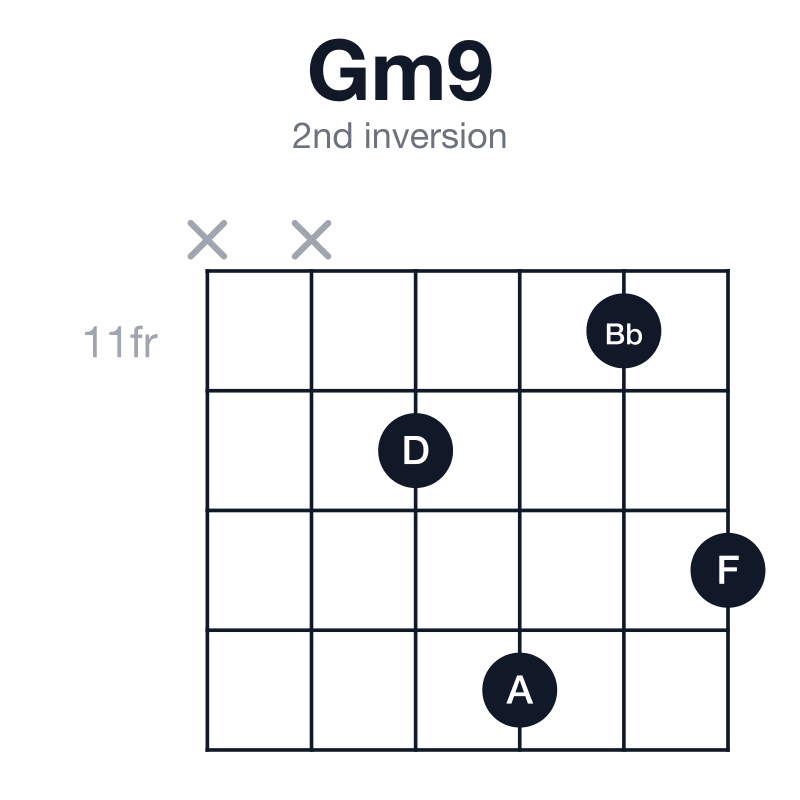
Gm9 in 2nd inversion puts D in the bass instead of G, the 5th of the chord. The notes are the same; what changes is what the bass line does, which is most of why you would reach for it — it lets the lowest voice move by step where the root would have jumped.
One of Gm9’s 9 common shapes does this:x-x-12-14-11-13
Play Gm9 as a shell — root, third and seventh — and the spare string takes the 11 (C) or the 13 (E).
All 9 common shapes as fret numbers, lowest string first. Hover or tap one to see it drawn.
- 300331, open position, G, root position, top note F, barred
- 31x231, 1st fret, G, root position, top note F, all fretted
- x13233, 1st fret, Bb, 1st inversion, top note G, barred
- 353335, 3rd fret, G, root position, top note A, barred
- xx7066, 6th fret, A, 9th in the bass, top note Bb, 1 open string
- 687786, 6th fret, Bb, 1st inversion, top note Bb, all fretted
- x-10-8-10-10-x, 8th fret, G, root position, top note A, barred
- x-12-12-12-11-13, 11th fret, A, 9th in the bass, top note F, barred
- x-x-12-14-11-13, 11th fret, D, 2nd inversion, top note F, all fretted
How to use Gm9
How you get to it. The turn that lands on Gm9 is Am7♭5 to D7♭9: the ii and the V of G minor, which is where a minor tonic is usually arrived at rather than simply begun on.
In which keys. Every note of Gm9 belongs to D minor (the iv, the subdominant), F major (the ii, the supertonic), G minor (the i, the tonic) and Bb major (the vi, the submediant).
What to play over Gm9
Every note of Gm9 is in G dorian and G natural minor.
Chords near Gm9
Change one note of Gm9 and you have Gm69 (the flat seventh becomes the sixth), Gm7 (drop the ninth), Gm11 (add the eleventh), GmMaj9 (the flat seventh becomes the major seventh), Gmadd9 (drop the flat seventh) or G9 (the minor third becomes the major third).
Gm9 is a minor chord — root, minor third, fifth. Minor chords on every root.
The common shapes and the derived voicings come from different places, and both are explained in how this site is built.