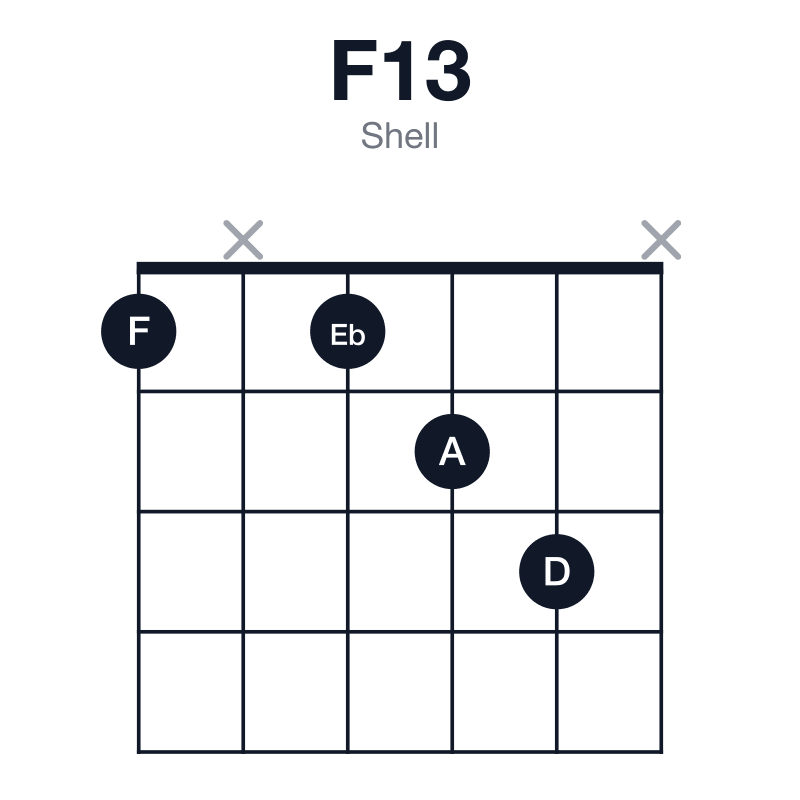
F13 guitar chord

Shell · strings 6432 · Root position1 of 3

Root, third and seventh: the guide tones fix the quality, so the fifth is dropped. That is what leaves a string free, so pick a tension to put on top.

Tension
  • Tap a note to hear it
  • Arrows change position
  • Fingers, notes or intervals
  • Play the chord
About F13shell voicings

F13 is F, A, C, Eb, G and D F9 with the thirteenth added on top.

It sounds big and open. Six notes will not fit under four fingers: the fifth goes first, then the ninth, and the third, flat seventh and thirteenth stay.

F13 shell guitar chord diagram: F, A, C, Eb, G, D, played 1x123x
F13 shell, 1x123x — the shape above, as a picture.

F13 notes and formula

Notes and interval formula
FACEbGD
135♭7913

Dominant — the full V chord.

Also written Fdom13 or F dominant 13. The same chord either way; which spelling you meet depends on who wrote the chart.

How to play F13

Shell voicing
R35♭7

Root, third and seventh. The third and seventh, the guide tones, are what make the chord major, minor or dominant, so the fifth can go: it says nothing the symbol needs.

Three notes means a spare string, which is the real point. Put a tension on it.

F13 has 3 of them, on strings 6-4-3-2 and strings 5-3-2-1, from open position up to the 13thall in one inversion, so the bass note never moves. The one to learn first is the F shape at the nut.

Start with x-8-7-8-10-10no barre. None of the shapes for F13 uses an open string, so every one of them is movable; the lowest sits at the 1st fret. 6 of the 7 need a barre. Together they cover the neck from the 1st fret to the 15th.

Every common shape for F13
FretsWhereBassTopHand
1112331st fretF, root positionGbarred
x-8-7-8-10-107th fretF, root positionDall fretted
x-8-7-8-8-107th fretF, root positionDbarred
8-8-8-8-10-108th fretC, 2nd inversionDbarred
13-10-12-10-10-1110th fretF, root positionEbbarred
13-12-12-12-13-1111th fretF, root positionEbbarred
13-13-13-14-15-1513th fretF, root positionGbarred

The same notes rebuilt from scratch give 13 drop 2, 9 drop 3, 25 rootless and 5 open string voicings, each on its own page.

Tensions. A shell of F13, root, third and seventh, leaves a string free, and the tones that belong over it are the #11 (B).

How to use F13

F13 is the V of Bb, and that is where it goes if it goes anywhere: the third and the flat seventh are a tritone apart, and both resolve by a semitone into Bb.

Voice by voice, F13Bb. 2 voices move by a semitone, and 2 notes are common to both chords.

In F13MovesIn Bb
F, the rootstays where it isF, the fifth
A, the major thirdrises a semitoneBb, the root
C, the fifthfalls a whole toneBb, the root
Eb, the flat seventhfalls a semitoneD, the major third
G, the ninthfalls a whole toneF, the fifth
D, the thirteenthstays where it isD, the major third

In which keys. Every note of F13 belongs to G minor (the ♭VII) and Bb major (the V, the dominant).

What to play over F13

Every note of F13 is in F mixolydian and F lydian dominant.

Chords near F13

Change one note of F13 and you have Fmaj13 (the flat seventh becomes a major seventh), F69 (drop the flat seventh), F9 (drop the sixth) or F9#11 (the sixth becomes a flat fifth).

F13 is a dominant chord — root, major third, fifth, minor seventh. Dominant seventh chords on every root.

On F13’s sound and use this page follows Ted Pease & Ken Pullig, Modern Jazz Voicings (Berklee Press, 2001). The shapes and the derived voicings come from different places, and both are explained in where the chords and the theory come from.

Midi Settings

7.5
Play Style
One pass of the pick from the lowest string up, everything left ringing.
Instrument
350
150

Style

Shows each chord the way this style would voice it, and marks which of its alternatives belong to the idiom.

Layout

Left Handed Mode